
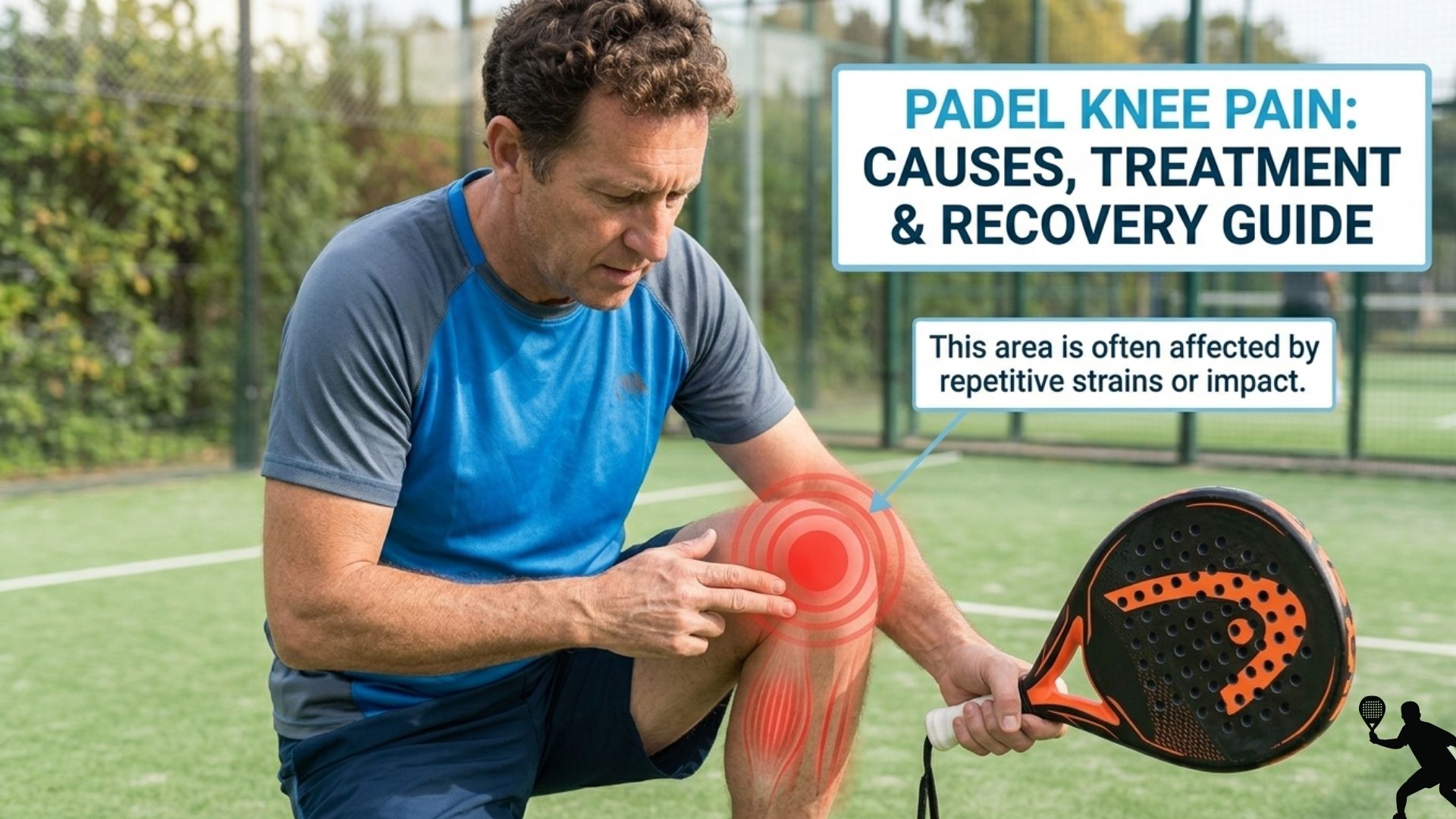
PADEL KNEE PAIN
Caused by repeated lateral cuts, hard stops, and high-impact lunges. It usually starts as a dull ache — if ignored, it limits your first step.
In plain words
Knee feeling unstable after a jump on the court? Let’s look at an ACL injury.
- Other things that might raise your risk of an ACL injury include body mass index, a smaller femoral notch, impingement on the notch, a smaller ACL, hypermobility, joint laxity, and previous injury. Source: ncbi.nlm.nih.gov
- Injuries to your knee bands (ligamentous injuries) can cause pain, swelling, and instability. They can feel just like meniscus tears and sometimes even happen at the same time. Source: nih.gov
- When putting weight on your legs, women’s knees move inward (knee abduction) more than men’s. This increases the risk of kneecap pain (patellofemoral pain) and front cruciate ligament tears. Source: europepmc.org
- Kneecap tendon overload (patellar tendinopathy) in padel comes from repeated stress on the tendon. This happens especially during movements where your thigh muscle works while lengthening (eccentric quadriceps loading), like jumping, landing, and quick direction changes. Source: aaos.org
- Injuries to your inner knee ligament (medial collateral ligament) often happen in sports, especially during skiing. Source: ncbi.nlm.nih.gov
- Although a front cruciate ligament (ACL) injury can be diagnosed by a doctor’s exam, a magnetic scan (MRI) is often used to confirm it. Source: ncbi.nlm.nih.gov
Easy-read versions of the sourced facts on this topic — written with AI assistance and checked against the wording of each source. Not a substitute for medical advice.
Answer 3 questions to understand your injury level and what to do next.
Rest 3–5 days. Apply ice 15 min after activity. Strengthen quads with seated leg extensions.
Avoid lateral cuts and deep squats for 3 weeks. Start a quad/VMO strengthening programme.
Pain at rest, swelling, or giving-way are red flags. See a physiotherapist or sports doctor before returning to court.
What Is Padel Knee Pain?
Padel knee pain is not a single diagnosis — it is a family of overuse conditions that share the same root cause: too much load, too fast, on a joint that was not ready for it. The most common version is patellar tendinopathy, sometimes called jumper’s knee, which affects the tendon just below the kneecap.
In padel, the knee takes a beating that most other sports do not deliver. Every split-step loads it. Every lateral cut demands a sudden deceleration. Every hard stop on a concrete court sends shock straight through the joint. The knee is not injured — it is overloaded.
This is where most players go wrong. They rest for a week, the pain fades, and they come back at the same intensity on the same surface with the same weak hips. Two weeks later the pain is back — and sometimes worse than before.
Is Padel Knee Pain the Same as Jumper's Knee?
Yes — patellar tendinopathy (jumper's knee) is the most common diagnosis behind padel knee pain. The lateral cuts and explosive stops in padel deliver the same repetitive tendon load as jumping sports. If you've been diagnosed with jumper's knee before, the rehab principles here apply directly.
What Is the Difference Between Padel Knee Pain and a Meniscus Injury?
Tendinopathy pain builds gradually and is typically felt below the kneecap on activity. Meniscal pain often comes from a specific twisting moment, is felt on the inside or outside of the joint line, and may include locking, catching, or the knee giving way. If your knee pain started suddenly after a twist and includes any of those sensations, see a physiotherapist — a meniscal injury needs different management.
Common Symptoms of Padel Knee Pain
Padel knee pain almost always starts quietly. The first sign is usually stiffness the morning after a match, or a dull ache when you walk down stairs. The pain is mild and fades with activity — which is exactly why most players ignore it.
By the time the pain shows up during matches and lingers afterward, the tendon has already progressed. That is when recovery takes weeks instead of days. The earlier you catch it, the faster the fix.
Why Padel Players Get Knee Pain
It is rarely one moment — it is the accumulation
Too much volume, too fast
Going from 1–2 sessions a week to 4–5 without building the leg strength to absorb the extra load. Tendons adapt slower than muscles — usually 8–12 weeks.
Weak hips and glutes
When the hips can’t stabilize on a lateral cut, the knee collapses inward and takes the force. This is the hidden cause of most padel knee pain — and almost no one trains for it.
Wrong shoes on a hard court
Running shoes or worn-out trainers do not absorb lateral impact the way padel-specific shoes do. Playing on concrete or hard synthetic surfaces multiplies the load.
Knee pain rarely shows up alone. If you also get tight calves after matches or lower back stiffness the next morning, those are usually part of the same chain — read our guides on calf and Achilles pain and lower back pain in padel for the full picture.
Treating Padel Knee Pain — Phase by Phase
Skip a phase and the pain usually comes back
Acute Phase
- Stop matches — no exceptions
- Ice 15 min, 2–3x daily if swollen
- Short-course NSAIDs if needed
- Gentle mobility, no loaded squats
Sub-Acute Phase
- Isometric quad holds (5x 45 sec)
- Slow eccentric squats to 60°
- Glute bridges and side-lying clams
- Hip mobility work daily
Return to Play
- Bulgarian split squats and lunges
- Lateral plyometrics (low volume)
- Return to matches: 1 a week first
- Fix the shoes and surface issues
"You're not broken. Most players feel this exact pain and assume the worst. What actually works is addressing why the tendon loaded — not just how much."
In short: Most padel knee pain comes from sudden lateral movements and the quick stop-and-start nature of the sport, hitting your knees hard. The key isn't resting it away—it's addressing movement patterns. Focus on strengthening your glutes and improving lateral stability, then gradually return to court with proper footwork. For most players, this beats sitting on the sidelines.
FROM OUR COACHING TEAM
We've found that lateral movement stress is the primary culprit behind knee pain in padel players. The constant side-to-side pivoting puts tremendous strain on the medial ligaments and cartilage. In our experience, recovery requires a combination of targeted strengthening exercises for the stabilizer muscles and strategic court positioning to reduce explosive lateral movements. What we recommend is gradual return to play with proper warm-up protocols.
FROM OUR COACHING TEAM
We've seen this exact pattern with hundreds of padel players — a knee tweak that gets ignored for two weeks turns into a month off court. What we've found is that the return-to-sport phase is where most re-injuries happen. Our protocol deliberately slows this down: we test single-leg stability and lateral control before we clear anyone for match play. What we know for certain is that rushing the final 20% costs more time than taking it carefully.
CLINICAL EVIDENCE
Our recommendations are grounded in peer-reviewed research. Key studies we've drawn from:
- Incidence, prevalence and nature of injuries in padel: a systematic review — BMJ Open Sport & Exercise Medicine, 2023
- Evaluation and management of knee pain in young athletes: overuse injuries of the knee — Sports Health, 2016
FROM OUR COACHING TEAM
We've found that padel knee pain often stems from explosive lateral movements and sudden direction changes. In our experience, patellofemoral pain develops when players lack proper hip stability and quad strength. What we recommend is gradual return to court with specific strengthening drills—single-leg squats, lateral lunges, and controlled pivoting exercises. We know that addressing glute weakness early prevents compensation patterns. Our approach combines on-court technique refinement with targeted conditioning to build resilient knees.
What Recovery Actually Looks Like
Players always ask for the single number: "when can I play again?" Padel knee pain does not work that way. Recovery depends on how deep the tendon irritation has gone, whether you address the real cause (usually the hips, not the knee), and whether you change what you were doing before.
Here are realistic milestones for a mild-to-moderate case. Chronic cases take longer and usually need a full recovery protocol plus input from a physiotherapist.
Non-negotiable rule: return to play is based on strength milestones, not how you feel. Pain fades long before the tendon is fully healed. Coming back on feel alone is the #1 reason padel knee pain recurs.
How to Stop It Coming Back
This is the most important section on the page. Treatment gets you back on court. Prevention is what keeps you there. The biggest mistake players make after padel knee pain is assuming the fix is rest — and then returning to the exact same habits that caused it.
Real prevention means building strength where the knee is actually weak: the hips and glutes that should absorb the load, and the quads that should decelerate your body on every lateral cut. Add a proper warm-up and targeted mobility, and recurrence rates drop dramatically.
We’ve seen chronic padel knee pain disappear in 10–12 weeks when players commit to three things: twice-a-week strength, daily mobility, and a real pre-match warm-up. No injections. Just the boring stuff, done consistently.
When It Is Time to See a Professional
Most padel knee pain responds to rest, rehab, and the plan above. A few situations are beyond self-treatment and deserve a physiotherapist or sports doctor. None of these are emergencies — but they are signals that you need expert eyes on it.
- Sharp pain that has not improved after 4 weeks of rest
- Visible swelling, bruising, or a feeling of instability
- The knee locking, catching, or giving way under load
- Pain so bad it affects walking or sleep
- A popping sound at the moment the pain started
Keep Building the System
The guides that pair best with this one
Is Padel Knee Pain the Same as Jumper's Knee?
Yes — the two terms describe the same condition from different angles. Jumper's knee is the clinical name (patellar tendinopathy). Padel knee pain is how players describe the symptom. In padel, every split-step, lateral cut, and explosive first step loads the patellar tendon in the same way jumping does in volleyball or basketball. The biomechanics are different but the tendon pathology is identical.
Why Does Padel Knee Pain Get Worse After Sitting Down?
This is the post-exercise stiffness window: blood flow to the tendon drops when you stop moving, and the tendon cools and tightens. When you stand up again, the first few steps reload a cold tendon before it has warmed up. The result is the familiar "stair test" pain. It usually eases after 5 minutes of walking. If it does not ease at all, the tendon irritation is more advanced than mild.
Can Padel Knee Pain Cause Permanent Damage?
In the vast majority of cases, no. Patellar tendinopathy that is caught early and treated properly heals without permanent structural changes. The risk of permanent damage comes from ignoring it and continuing to play at full intensity — that is how mild tendinopathy progresses into degenerative tendon changes that take 6–12 months to resolve and occasionally require more invasive intervention. Treat it early. The tendon itself recovers very well with the right protocol.
Why Do Padel Players Get Knee Pain More Than Other Racket Sport Players?
Padel demands a uniquely high volume of lateral deceleration in a small court space. Unlike tennis, where rallies often allow a full split-step and set, padel's enclosed court creates constant reactive movement with no time to reset. The glass walls mean balls stay in play longer, extending rallies and cumulative tendon load. Additionally, many padel players come from non-athletic backgrounds and lack the hip and quad baseline strength that absorbs the lateral cutting load before it reaches the knee.
| What it is | Patellar tendinopathy, also known as "Jumper's Knee," primarily involves the patellar tendon, which connects the inferior pole of the patella to the tibial tuberosity and is crucial for knee extension. (nih.gov, aaos.org, orthopedicsri.com) |
| Why padel causes it | Patellar tendinopathy in padel and other racket sports results from repetitive mechanical stress and overload on the patellar tendon, especially during activities with high eccentric quadriceps loading like jumping,… (nih.gov, aaos.org, orthopedicsri.com) |
| Main symptom | The hallmark symptom of patellar tendinopathy is localized anterior knee pain at the inferior pole of the patella, which is aggravated by activities like jumping, landing, running, and squatting. (nih.gov, aaos.org, orthopedicsri.com) |
| First-line treatment | First-line conservative treatment for patellar tendinopathy emphasizes load management, which involves reducing aggravating activities while avoiding complete rest, and gradually increasing load within a pain-free… (nih.gov, aaos.org, orthopedicsri.com) |
| Returning to play | Return-to-play for patellar tendinopathy is criteria-based, requiring pain-free or minimal pain (<2/10 VAS) during and after full sport-specific activities, full range of motion, and symmetrical quadriceps strength… (nih.gov) |
| Prevention | Prevention of patellar tendinopathy involves progressive overload and deloading strategies, including gradual increases in training load (e.g., no more than 10-15% per week) and incorporating planned deload weeks. (nih.gov, orthopedicsri.com, primalphysiotherapy.com.au) |
Acute, sudden, severe pain with a "pop" or "tear" sensation, inability to actively straighten the knee, or a palpable gap at the bottom of the kneecap are red flags indicating a possible patellar tendon rupture, requiring urgent medical referral.
Source: nih.gov, aaos.org, orthopedicsri.com
Padel Knee Pain: Frequently Asked Questions
Quick answers to what players ask most
How long does padel knee pain take to heal?
A mild to moderate case typically takes 4–8 weeks with proper rest and rehab. Chronic or advanced cases can take 3–6 months and usually need a physiotherapist-led protocol.
Can I keep playing with padel knee pain?
No. Playing through tendon pain turns a short-term problem into a long-term one. Stop matches, follow the treatment phases above, and return based on strength, not on pain level.
Is it better to rest or stay active for padel knee pain?
Active recovery wins. Complete rest weakens the tendon further. Gentle mobility, quad isometrics, and hip strengthening all help — matches and plyometrics do not.
Will a knee brace fix padel knee pain?
A brace can reduce symptoms during activity but it does not treat the underlying tendon or the weak hips driving the pain. Use it as a short-term aid during return to play, not as a permanent fix.
Can padel knee pain come back after it heals?
Yes, and it often does if you return to the same habits. Prevention means permanent changes: strength training, daily mobility work, and managed match volume.
Is padel knee pain the same as jumper's knee?
Yes — the most common form of padel knee pain is patellar tendinopathy, also called jumper's knee. Padel delivers the same repetitive tendon load as jumping sports through lateral cuts, split-steps, and explosive starts. If you have been diagnosed with jumper's knee in another sport, the rehabilitation protocol in this guide applies directly.
Does padel knee pain cause swelling?
Mild swelling around the kneecap is common with patellar tendinopathy during the acute phase. Significant swelling, bruising, or instability (the knee giving way) are different signals — those can indicate a meniscal or ligament issue and warrant a physiotherapy assessment. If your knee swells visibly after every match, do not continue playing and see a professional.
Can I cycle or swim with padel knee pain?
Usually yes — cycling and swimming are excellent low-impact alternatives during the sub-acute phase. Cycling in a comfortable gear with the seat height adjusted to avoid deep knee bend keeps tendons active without loading them through the painful range. Swimming (especially kicking drills) should be pain-free. If either activity causes knee pain, stop that too and stick to upper body exercise until the tendon calms.
What exercises make padel knee pain worse?
Anything involving rapid loading through a bent knee: deep squats, jumping, plyometrics, fast lateral shuffles, and return to match play too early. In the acute phase, avoid all of these. In the sub-acute phase, introduce slow, controlled eccentric exercises only. Isometrics (static holds) are typically the safest first exercise choice for irritated tendons.
How do I know if my padel knee pain is serious enough to need surgery?
The vast majority of padel knee pain cases — including chronic patellar tendinopathy — resolve with conservative treatment (rest, exercise rehab, load management) without surgery. Surgery is rare and reserved for complete tendon ruptures or persistent severe cases after 6+ months of proper rehab. If you have been told surgery is an option after less than 12 weeks of treatment, it is worth getting a second opinion.
Play Padel Pain-Free. Protect Your First Step.
Strong knees are not about rest — they are about the right work. Three habits: strength, mobility, warm-up. Do them consistently and your next 200 matches feel lighter than your first ones.
Back to the Treatment Plan ↑If you want a specialist in Spain who understands padel knee injuries, we have manually reviewed the options.
Find a trusted padel injury specialist in Spain →
