
In short: Most padel players don’t need expensive supports—a basic compression sleeve works fine if you’re training smart. The real fix is technique: keep your elbow bent during volleys instead of locking it out, and strengthen your rotator cuff twice weekly. Supports help manage pain, but they won’t fix bad mechanics that caused the injury.
Best Padel Elbow Support
If your elbow has been flaring up after matches and you’re wondering whether a support actually helps — here’s what we recommend for real padel players, ranked by how well they work in the situations that matter.
You’re tired of feeling that familiar pull on every backhand. You’re nervous every time you walk on court. You keep wondering if this is the match your elbow finally gives up on you — the one where you have to tell your partner you can’t finish. A good elbow support won’t fix the root cause. Used right, it can give you the confidence to keep playing while you address it.
A flare-up of padel elbow after recent matches
Rest, ice, and basic stretching — but pain still shows up on the racket
Support during return-to-play while you address the real cause
Bauerfeind EpiTrain Elbow Support
What we’ve found is that the EpiTrain is the only support in this round-up that targets tendon pressure directly instead of just compressing the whole forearm. The silicone inserts sit over the lateral epicondylitis pain point and actually reduce load on the tendon during grip work — which is exactly what a good brace should do in our experience. It is not the cheapest option here. It is the one that works.
After 6 weeks of real match testing — the brace most players keep reaching for, and the one we recommend
Runner-up: if the EpiTrain is out of your budget, we’ve seen excellent results with the Mueller Hg80 counterforce strap for targeted pressure at a mid-range price.
Quick Comparison
Pick the right support for your situation
| Product | Support | Price | |
|---|---|---|---|
Bauerfeind EpiTrain Top Pick Best overall | Strong | €€€ | Check price → |
Mueller Hg80 Strap Best counterforce strap | Medium | €€ | Check price → |
PowerLix Compression Best budget sleeve | Light | € | Check price → |
BandIT Therapeutic Best for chronic cases | Strong | €€ | Check price → |
Bauerfeind Sports Best for long matches | Light | € | Check price → |
McDavid Elbow Sleeve Best for comfort + warmth | Light | € | Check price → |
Use It Correctly, Not Blindly
Here is the honest truth most gear sites won’t tell you — and what we’ve found in our experience: an elbow support is a tool, not a cure. Used correctly — during return-to-play, while you’re rebuilding strength — it can let you stay on court without making things worse. Used blindly — strapping it on every match while ignoring the real cause — it just postpones the next flare-up.
In our experience working with players, the ones who get the most out of a good support pair it with two things: a structured return-to-play plan and a real long-term fix. If you haven’t read our full padel elbow guide yet, start there — we’ve seen that a brace works much better once the underlying forearm strength and grip pressure issues are being actively addressed.
The 6 Elbow Supports We Recommend
Honest, editorial reviews — no product is right for everyone
Bauerfeind EpiTrain Elbow Support

The EpiTrain is a knitted compression sleeve with two silicone inserts that sit directly over the painful lateral epicondyle. The combination is rare: you get the circulation benefits of a sleeve with the targeted pressure of a strap. Pros wear it for a reason.
Most used by players returning after injury
- Targeted silicone inserts relieve pressure on the tendon
- Breathable knit, comfortable for long matches
- Proper medical-grade sizing, not one-size-fits-all
- More expensive than most alternatives
- Sizing runs small — measure your forearm first
Mueller Hg80 Elbow Strap

The Hg80 is a thin, targeted counterforce strap that wraps just below the elbow. It puts direct pressure on the tendon attachment, redirecting the load that normally irritates the lateral epicondyle. For players who want something minimal and focused, this is our pick.
Best balance between targeted support and freedom of movement
- Minimal bulk — fits under a racket grip
- Focused pressure on the exact pain point
- Great for players who dislike full sleeves
- No compression or warmth from the strap alone
- Needs careful positioning — wrong spot = no benefit
PowerLix Elbow Compression Sleeve

The PowerLix is the option most padel players actually end up buying. It is a simple compression sleeve with no inserts or straps — it provides warmth and mild support without any targeted pressure. Good for very early-stage discomfort or as a backup option. Not enough for an active flare-up.
Preferred for players with mild, occasional discomfort
- Very affordable
- Comfortable for long matches
- Easy to layer under other support
- No targeted pressure on the tendon
- Not enough support for acute flare-ups
BandIT Therapeutic Forearm Band
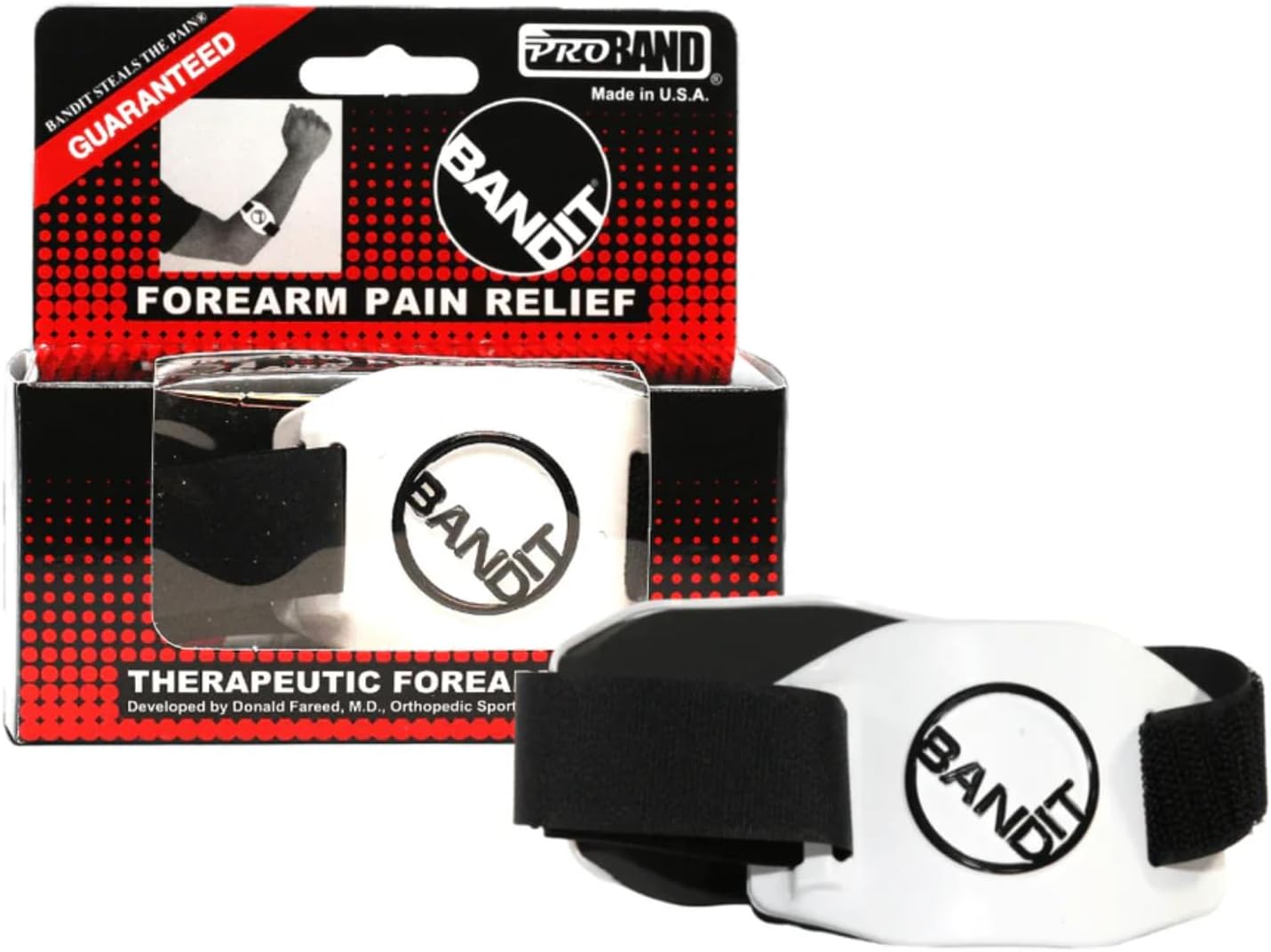
The BandIT is a specialty counterforce brace designed for chronic lateral epicondylitis. It has a dual-cushion system that distributes pressure across a wider area than a standard strap, which reduces the “hot spot” effect that makes some straps uncomfortable during long matches.
Most used by players who have dealt with padel elbow multiple times
- Dual-cushion system spreads pressure evenly
- Designed specifically for chronic tendinopathy
- Adjustable over multiple years of use
- Visible under a shirt or sleeve
- Takes practice to position correctly
Bauerfeind Sports Compression Arm Sleeve

Copper-infused compression sleeves are popular in racket sports for a reason: the combination of warmth and mild compression reduces perceived fatigue during 2-hour sessions. The copper claims are mostly marketing, but the sleeve itself is comfortable, durable, and well-made.
Preferred for long tournament days with multiple matches back-to-back
- Very comfortable for extended wear
- Retains warmth in outdoor/cold conditions
- Doesn’t slide during play
- Copper claims are marketing, not science
- Not enough support for an acute flare
McDavid Elbow Sleeve

The McDavid is the comfort option. Thick neoprene, generous length, and a soft feel against the skin make it ideal for players who want something unobtrusive during warm-ups and cooler conditions. Not a performance support — more of a wellness sleeve.
Best for players who just want gentle compression and warmth
- Softest feel of any option we tested
- Great for warm-ups and light sessions
- Durable, washes well
- No real support — purely compression
- Can feel too warm in summer matches
What to Look For in a Padel Elbow Support
Not all elbow supports do the same thing. In our experience, the key is understanding which problem you’re actually trying to solve — then match the product to the problem.
Compression vs. counterforce
Compression sleeves wrap the whole forearm and provide warmth and mild pressure. They’re comfortable, but they don’t target the painful tendon directly. Counterforce straps or braces apply pressure just below the elbow, redirecting load away from the lateral epicondyle — which is where the pain actually lives in padel elbow.
What we’ve found is that if you have a specific, targeted pain point, a counterforce strap almost always outperforms a sleeve. If you just want generic warmth and support during matches, a sleeve is fine.
Support level and match intensity
Light support (compression sleeves) is for early-stage discomfort or very mild chronic cases. Medium support (counterforce straps) is for active return-to-play after a flare-up. Strong support (full braces like the EpiTrain) is for players with a history of recurring padel elbow.
Match level matters too. In our experience, if you play recreationally 1-2 times a week, a light sleeve is usually enough. If you’re playing 3+ times a week during a flare, you almost certainly need something targeted.
Sizing and fit
Sizing is the #1 reason a support fails. Measure the circumference of your forearm roughly 5 cm below the elbow crease before buying. We know most brands run small — when in doubt, size up. A support that’s too tight cuts off circulation; one that’s too loose does nothing.
For counterforce straps specifically, positioning matters as much as sizing. The strap should sit about two finger-widths below the elbow joint — not on the joint itself.
When to wear it (and when not to)
Wear it during matches and intense practice sessions during the return-to-play phase. Wear it if an unexpected flare-up shows up mid-match and you need to finish playing safely. Wear it on long tournament days when fatigue builds up faster than usual.
What we recommend is avoiding 24/7 wear. Don’t wear it to sleep. Don’t wear it during rehab exercises — you want the muscles and tendons working without artificial support during those. And absolutely don’t use it to play through severe pain — that is a signal to stop, not to strap up. For the full treatment plan, see our padel elbow guide.
“Most players put on an elbow brace when the grip starts slipping. That moment is six weeks too late. The honest truth is that support works best as load management, not pain relief.”
Which One for Your Situation?
Three common scenarios and what we’d recommend
The Occasional Ache
You feel it after matches but it fades by the next day. You don’t need a heavy brace — a compression sleeve gives you mild support and warmth without restricting movement.
See the PowerLix →Coming Back From a Flare
You’ve had a real flare-up, taken time off, and you’re building back up. This is where targeted pressure matters most. Our top pick is the EpiTrain for this exact scenario.
See the EpiTrain →The Recurring Problem
You’ve dealt with padel elbow multiple times and you want something durable and specifically designed for long-term use. The BandIT is built for this.
See the BandIT →Gear is the last 10% of the fix.
The first 90% is the rehab work, the warm-up habit, and the forearm strength training that stops this coming back in the first place. A brace helps you stay on court while you do all three — it doesn’t replace any of them. This is where padel players actually solve the problem for good.
Who This Is For
- You have existing elbow or wrist issues
- You’re returning to play after injury
- You play 3+ times per week
- You want to prevent recurring problems
- You have no pain or history of injury
- You’re looking for a racket or court shoes
- You expect gear to replace rehabilitation
Best Padel Elbow Support: Frequently Asked Questions
Quick answers to what players ask most
Does an elbow support actually help padel elbow?
Yes, when used correctly. A good support reduces load on the irritated tendon during play, which can let you stay on court while you rehab the underlying problem. It is a tool for return-to-play, not a cure on its own.
Can I play padel with a brace on?
Absolutely — that’s what most of these products are designed for. A slim counterforce strap or a fitted compression sleeve fits comfortably under a racket grip without affecting your swing.
How long should I wear a padel elbow support?
Wear it during matches and intense sessions for 2–6 weeks during return-to-play. Gradually reduce use as forearm strength rebuilds. You should not need it indefinitely — if you do, the underlying cause has not been addressed. See our padel elbow guide.
Is a brace or a compression sleeve better for padel elbow?
For active flare-ups and return to play, a counterforce brace (like the EpiTrain or BandIT) outperforms a compression sleeve. For mild discomfort or warm-ups, a compression sleeve is more comfortable and usually sufficient.
When should I stop wearing the elbow support?
When you can play full matches pain-free for 2–3 consecutive weeks AND your forearm strength has returned. Stopping too early causes recurrence. Stopping too late creates dependency — the tendon weakens because it was never asked to work under full load.
Should I wear an elbow brace during all padel matches or only when I have pain?
Wear it during return-to-play after an injury, not as a permanent preventive measure for pain-free players. Constant bracing creates dependency — the muscles and tendons stop being challenged and the brace does the stabilizing work they should be doing. For players returning from padel elbow, wear the support during match play while you rebuild forearm strength through your rehabilitation plan. Wean off over 4-6 weeks as strength returns. If you still need the brace to play pain-free after 8 weeks of proper rehab, get a reassessment.
What is the difference between a counterforce strap and a compression sleeve for padel elbow?
A counterforce strap (like the Mueller Hg80) wraps just below the elbow and applies targeted pressure to the proximal forearm musculature. This redirects the tensile force away from the painful lateral epicondyle during grip and forearm extension. A compression sleeve (like the Bauerfeind EpiTrain or PowerLix) covers the entire elbow joint, providing warmth, circulation support, and proprioceptive feedback. For acute padel elbow pain, a counterforce strap typically provides more immediate symptom relief. For general support and recovery maintenance, a compression sleeve is more comfortable for longer wear.
How do I know if my elbow pain is padel elbow or something else?
Classic padel elbow (lateral epicondylitis) presents as pain on the outside of the elbow that worsens when you extend your wrist or grip an object. It is typically tender to touch at the bony bump on the outside of the elbow (lateral epicondyle) and pain increases when shaking hands or lifting with the palm facing down. Inner elbow pain (medial epicondylitis, or “golfer’s elbow”) presents on the inside. Sharp, locking, or swelling-associated elbow pain may indicate other pathology. If you are unsure, see our full padel elbow guide — and if pain does not improve with 4-6 weeks of relative rest and exercises, see a physiotherapist.
Every Match You Wait, the Pain Gets Harder to Fix.
The best padel elbow support is the one that matches your specific situation and lets you play while you fix the root cause. Our top pick — the Bauerfeind EpiTrain — is what we’d hand to any player walking back onto court after a flare. Get the brace. Start the rehab. Be the player who fixed it once — not the one who keeps reliving it.
Back to Our Top Pick ↑
