
In short: Calf and Achilles pain in padel usually comes from explosive movements and quick directional changes on court—your calves work overtime. The key is catching it early: mild tightness needs immediate rest and stretching, while sharp pain demands proper assessment before you’re back playing. Most players recover in two to four weeks with smart load management and targeted strengthening.
PADEL CALF PAIN
Tight calves and explosive lateral movements lead to strain and Achilles tendon pain. Feels like a tweak — but ignoring it ends seasons.
Answer 3 questions to understand your injury level and what we recommend next.
In our experience, no running for 5 days works well. Calf stretch 3× daily. Eccentric heel drops from day 3.
We recommend 2–4 weeks off court. Eccentric strengthening from day 5 if pain allows. What we’ve found is that gradual return to sprinting gives best results.
Sudden pop, bruising, or inability to weight-bear are what we see in partial or complete tears. These need urgent clinical assessment.
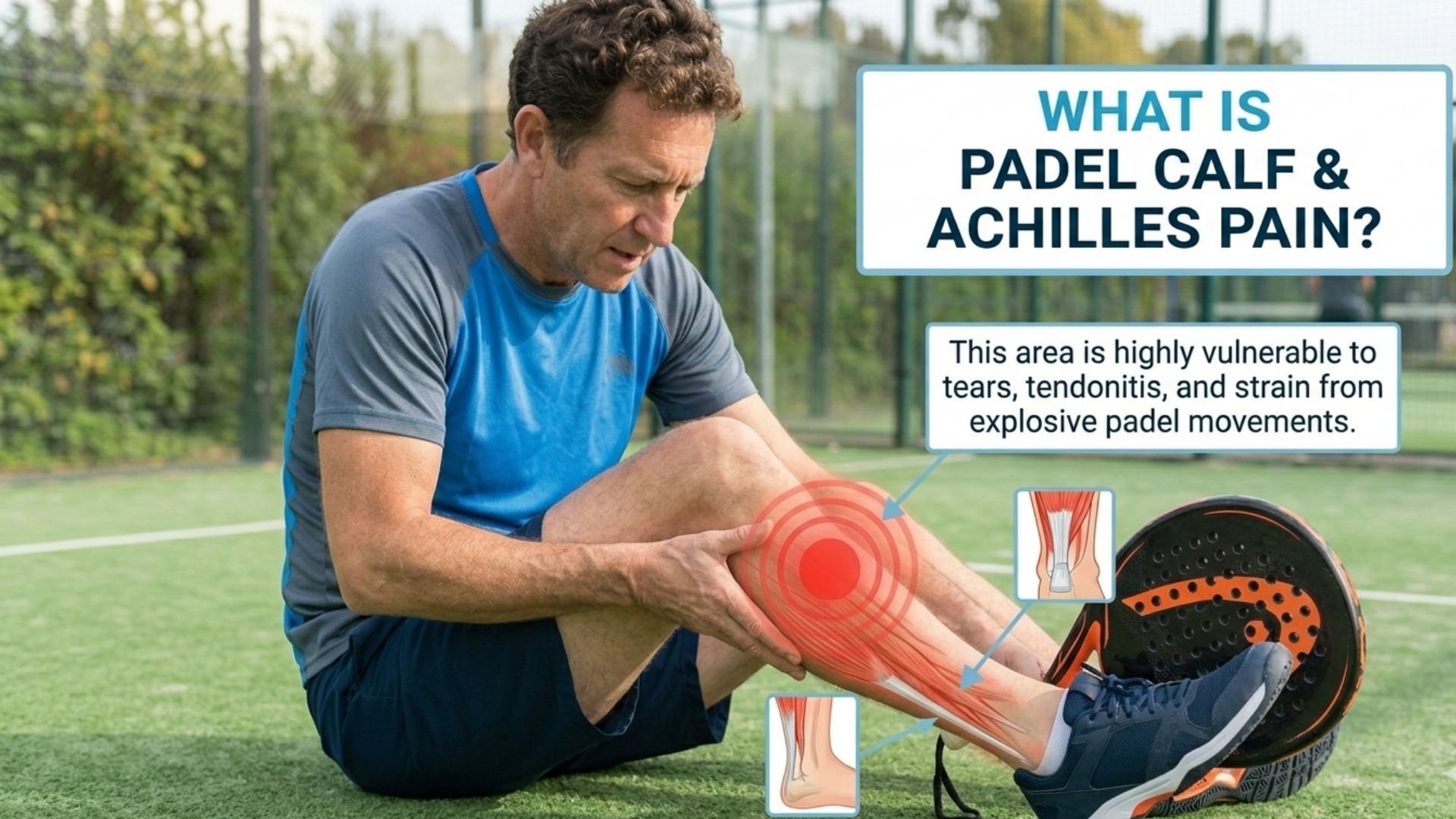
What Is Padel Calf & Achilles Pain?
Padel calf pain usually involves a muscle strain in the gastrocnemius or soleus — the two muscles that make up your calf. The gastrocnemius sits on top and does the explosive work. The soleus sits underneath and does the endurance work. Both take heavy load in padel, but in our experience, the gastrocnemius tears more often because of the explosive, cold-start nature of the sport.
Achilles pain is the other side of the same coin. The Achilles tendon connects both calf muscles to the heel. When the calves are tight, the tendon takes more load — and over time that turns into Achilles tendinopathy. We've seen chronic cases eventually rupture, which is one of the most serious injuries in padel.
This is where most players go wrong, and we know because we see it constantly. They feel the tight calf, massage it, and keep playing. The next match is when the strain becomes a tear — or worse, the tendon snaps. What we recommend is taking padel calf pain seriously from the start.
Common Symptoms of Padel Calf Pain
Padel calf pain can appear two ways. The sudden version: a sharp pulling sensation mid-sprint that feels like someone kicked you from behind — that's a calf strain or partial tear. The gradual version: tightness that builds over weeks, morning stiffness in the Achilles, and a nagging ache that never quite resolves.
We've found that the warning sign most players ignore is a subtle tightness after matches that they think is "just normal soreness". In our experience, if the calf feels tighter on one side than the other, or if stretching gives relief but it comes back quickly, the tissue is already overloaded.
Why Padel Players Get Calf & Achilles Pain
Three causes cover almost every case we see
Cold explosive starts
Going from zero to sprinting in the first rally — especially on a cold evening — is the #1 cause of acute calf strains in padel. The muscle is not ready and the tissue gives.
Accumulated load without recovery
The calves absorb every step. Playing 3–4 times a week without stretching, foam-rolling, or any recovery work builds up tension the muscle eventually can’t hold.
Weak calves that can’t handle match pace
Most amateur players never train calves. Match intensity demands power the muscle has never been asked to produce, and the weakest fibers tear first.
Calf pain almost never stays isolated. If your foot has been aching or your ankle feels unstable, those are usually part of the same chain — see our guides on padel foot pain and padel ankle pain.
"If you've ever felt that sudden grab mid-sprint, you know how the rest of the session goes. Most players return too early — and we did the same before we understood the phases."
Treating Padel Calf & Achilles Pain — Phase by Phase
Rush the return and the tear usually follows
Acute Phase
- Stop all running and sprinting
- Ice 15 min, 2–3x daily
- Compression sleeve if swollen
- Gentle calf raises in pain-free range
Sub-Acute Phase
- Progressive heel raises — both legs first
- Single-leg calf raises when pain-free
- Eccentric lowering for the Achilles
- No matches or sprinting yet
Return to Play
- Gradual reintroduction of explosive starts
- Plyometric work starts very small
- Return to solo drills before matches
- Permanent calf strength habit
What Recovery Actually Looks Like
Padel calf pain recovery depends entirely on what caused it. A grade 1 strain (minor fiber damage) heals in 2–3 weeks with rest. A grade 2 (partial tear) takes 4–8 weeks. A full gastrocnemius rupture or an Achilles tear is months and usually needs surgery. See our recovery guide for the wider protocol.
Most padel players are dealing with grade 1–2 calf strains. The milestones below assume that range. If you heard an audible pop or can’t rise onto your toes, stop and see a doctor today — that is a potential full rupture.
The non-negotiable rule: do not return to explosive starts just because the calf feels better. Walking normally is not the same as sprinting. Return based on pain-free single-leg calf raises — not on how you feel.
How to Stop It Coming Back
This is the most important section on the page. Treatment gets you back on court. Prevention is what keeps you there. Padel calf and Achilles pain has one of the highest recurrence rates in the sport because the thing that caused it — explosive starts on cold muscles — is almost always still happening.
Real prevention means three things: a warm-up that actually loads the calves progressively before match pace, twice-weekly calf strength work (both gastrocnemius and soleus), and a respect for the muscle when it tells you it is tight.
We’ve seen players with chronic calf issues stop getting flare-ups completely just by adding a 2-minute calf ramp-up to their warm-up and 3 sets of heel raises twice a week. Boring. Effective.
When It Is Time to See a Professional
Most padel calf pain responds to rest and rehab. A few situations are serious and need immediate professional attention — especially anything that feels like a tear or a rupture.
- An audible pop or "snap" at the moment the pain started
- Inability to rise onto the toes of the affected leg
- Severe swelling, bruising, or a visible dent in the calf
- Pain so bad you cannot put weight on the leg at all
- Pain that has not improved after 4 weeks of rest
Keep Building the System
The guides that pair best with this one
CLINICAL EVIDENCE
Our recommendations are grounded in peer-reviewed research. Key studies we've drawn from:
- Calf muscle strain injuries in sport: a systematic review of risk factors — British Journal of Sports Medicine, 2017
- The assessment, management and prevention of calf muscle strain injuries — Sports Medicine — Open, 2021
Why Does the Calf Tear During a Padel Match?
The calf tears when the muscle is asked to produce more force than it can handle — almost always during an explosive acceleration on a cold muscle. In padel, the combination of the split-step (loading the calf eccentrically as you react) and the push-off (concentric contraction to drive to the ball) creates a peak force demand. If the calf is tight from insufficient warm-up, fatigued from earlier matches, or simply undertrained for the load, this peak demand exceeds the muscle-tendon unit's capacity. In our experience, the typical padel calf tear moment is the push-off on the first explosive sprint of a match.
What Is the Difference Between Calf Pain and Achilles Pain in Padel?
Calf pain is in the muscle belly — the fleshy part of the lower leg. It typically follows a strain event (a specific moment when you felt a pull), produces tenderness on pressing the muscle, and is most painful when actively contracting (rising onto your toes). Achilles pain is at the back of the ankle, at the tendon itself, and is most painful in the first steps after rest or in the first minutes of activity (morning stiffness). We've found that the two conditions share the same risk factors and often coexist, but the treatment loading protocols differ slightly. See a physiotherapist if you are unsure which one you have.
Is Calf Tightness in Padel a Warning Sign?
Yes — persistent calf tightness that does not release with normal stretching is one of the clearest early warning signs before a calf strain. The muscle is telling you that demand is outpacing adaptation. What we see in our clinic is that ignoring it and continuing to play at full intensity, especially without warming up, is the direct path to a mid-match tear. If your calves are consistently tight on match days, treat it as a training signal: reduce volume temporarily, add specific eccentric calf strength work, and address the warm-up protocol.
Can Poor Padel Shoes Cause Calf Pain?
Yes, significantly. Running shoes used on padel courts create lateral instability that the calf compensates for, increasing involuntary tension throughout the match. Worn-out padel shoes that have lost their midsole cushioning transmit more impact directly into the calf-Achilles complex on each landing. Flat insoles in players with high arches or overpronation also shift load patterns through the calf. What we recommend is that if your calf pain started after changing shoes or increasing play on harder surfaces, footwear is the first variable to investigate.
| What it is | The gastrocnemius muscle is a superficial, two-headed muscle located in the posterior lower leg, forming the bulk of the calf and is part of the triceps surae. (wikipedia.org, visiblebody.com, teachmeanatomy.info) |
| Why padel causes it | Medial gastrocnemius muscle tears typically occur due to sudden, forceful movements involving rapid knee extension and ankle dorsiflexion, often combined with forceful plantarflexion, frequently encountered in racket… (clevelandclinic.org, nih.gov, jointandperformance.com) |
| Main symptom | A hallmark symptom of a medial gastrocnemius muscle tear is sudden, sharp pain in the calf, often described as feeling like being "shot" or "kicked," with many individuals reporting a "pop" or "snap" sensation at the… (clevelandclinic.org, nih.gov, floridaortho.com) |
| Rehab approach | Rehabilitation for a medial gastrocnemius tear progresses through phases, starting with acute protection (reducing pain/swelling) and moving to subacute early loading (restoring range of motion, gentle strengthening)… (clevelandclinic.org, optimalhealthlab.com.au, jointandperformance.com) |
| Returning to play | Return to play after a medial gastrocnemius tear should be criteria-based, requiring complete absence of pain during all activities, full symmetrical range of motion, and calf muscle strength of at least 90-100% compared… (clevelandclinic.org, optimalhealthlab.com.au, jointandperformance.com) |
| Prevention | Prevention of medial gastrocnemius tears involves progressive load management, avoiding sudden increases in training volume or intensity, and regular calf strengthening exercises, including eccentric training. (clevelandclinic.org, optimalhealthlab.com.au, harvard.edu) |
Signs of Deep Vein Thrombosis (DVT), including disproportionate swelling, severe pain, warmth, redness, and a palpable cord in the calf, are red flags requiring urgent medical referral.
Source: clevelandclinic.org, nih.gov, uw.edu
Padel Calf & Achilles Pain: Frequently Asked Questions
Quick answers to what players ask most
How long does padel calf pain take to heal?
A mild calf strain typically takes 2–4 weeks. A moderate strain takes 4–8 weeks. Full tears or Achilles ruptures are months and usually require medical intervention — those are not self-treatable.
Can I play padel with a tight calf?
Not until the tightness fully resolves. A tight calf is one bad sprint away from a strain. Stretching feels better temporarily, but the underlying overload needs time and strength work to resolve.
Should I stretch padel calf pain?
Gentle stretching helps, but it is not enough on its own. The real fix is eccentric strengthening — slow heel lowers — which rebuilds the tendon’s ability to absorb load. See our full stretching routine and pair it with strength work.
Is calf pain different from Achilles pain?
Related but different. Calf pain usually involves the muscle belly (gastrocnemius). Achilles pain is lower, at the tendon itself. Treatment overlaps heavily, and most players with one have early signs of the other.
Can padel calf pain come back after it heals?
Frequently, yes. The highest-risk period is the first 4 weeks after return. Strength and warm-up habits are what reduce recurrence — see our strength guide for the calf work that actually sticks.
What is the fastest way to recover from a padel calf strain?
In the first 72 hours: RICE (rest, ice for 15 min every 2 hours, compression bandage, elevation). No stretching — a freshly strained muscle tears more easily under stretch in the acute phase. After 72 hours: gentle range of motion without resistance, then progressive loading starting with double-leg calf raises, then single-leg, then eccentric single-leg lowering. The eccentric heel-drop protocol is the single most evidence-supported intervention for calf-Achilles rehabilitation. Do not rush the loading progression — the calf takes 4-8 weeks to fully rebuild tensile strength.
How do I know if I have a grade 1, 2, or 3 calf strain?
Grade 1: small number of muscle fibres torn. Mild pain and tightness, able to walk and do a single-leg calf raise (with pain). Recovery 2-3 weeks. Grade 2: significant partial tear. Moderate-severe pain, some swelling, difficulty walking, unable to do a single-leg calf raise. Recovery 4-8 weeks. Grade 3: complete muscle tear (rare). Severe pain, significant swelling, complete inability to push off. Recovery 3-4 months, may need surgical consultation. If you cannot walk without significant pain or limp 24 hours after the injury, see a doctor.
Can I cycle or swim with a calf strain?
Swimming (upper body drills) is possible from day 3-5 for grade 1 strains. Freestyle kicking should wait until the muscle can sustain the repetitive contraction without pain, usually week 2-3. Cycling is generally well-tolerated once walking is pain-free — the low-impact rotational load is gentle on the healing fibres. Avoid any exercise where you push through heel pain or calf pulling. Upper body gym work and gentle cycling are the best active recovery options during the first two weeks.
Does wearing a calf compression sleeve help padel calf pain?
A compression sleeve reduces swelling during the acute phase and provides proprioceptive feedback during return to play. It does not accelerate tissue healing or strengthen the muscle. For players returning to padel after a calf strain, a sleeve can reduce discomfort and the sense of instability during the first few sessions back. Long-term, it should not be relied upon as a permanent support — the goal is to build enough calf strength that the sleeve becomes optional.
Why do older padel players get more calf injuries?
Two main reasons. First, the calf-Achilles complex loses elasticity with age — the same explosive movement that a 25-year-old can absorb becomes a higher relative load for a 45-year-old with stiffer connective tissue. Second, older recreational padel players are often still playing at high intensity but may have reduced their dedicated strength and mobility work over the years. The body is less capable of the same demand but is still receiving it. The fix is the same as for younger players — adequate warm-up, consistent eccentric calf strength, and managed match volume — but the margins are smaller.
Play Padel Pain-Free. Protect Your Explosive First Step.
Strong, warm calves are not about rest — they are about respect. Two minutes of calf prep before matches, three sets of heel raises twice a week. That is the whole protocol. Do it and your explosive first step feels safer than it has in a long time.
Back to the Treatment Plan ↑
