
Best Knee Supports for Padel: The Right Support for Every Type of Knee Pain.
Padel puts your knees under constant stress — lateral movement, explosive direction changes, sudden stops, deep lunges. Hundreds of micro-loads per match, session after session. Most players don’t realise how much force their knees absorb until the pain stops them mid-point. Knee pain in padel is one of the most common complaints we hear — and it’s almost always preventable or manageable with the right approach.
This is not a “top 10 list.” It’s an honest guide about what helps, what doesn’t, and which type of knee support matches your specific issue.
Direction changes, lunges, and quick stops catch up with you. Most players don’t realize how much stress a single match puts on their knees until the pain stops them mid-point. We’ve been through it — the stiffness after a session, the sharp twinge during a lateral slide, the slow realisation that your knees need more than just rest. This guide comes from that experience.
A knee support can reduce stress during play. It cannot replace strength training, load management, or proper recovery.
Why Knee Pain Happens in Padel
The mechanics behind the most common knee complaints on court
Four Forces That Break Knees Down
Lateral movement stress
Every direction change loads the knee joint. Padel demands hundreds per match — side-to-side slides, diagonal sprints, and recovery steps. The medial and lateral ligaments absorb this force repeatedly, and without adequate strength, they start to protest.
Explosive stops and lunges
Deceleration forces are where most knee injuries start. The sudden stop before a volley, the deep lunge for a low ball, the explosive push-off to cover a lob — these movements generate forces several times your body weight through the patellar tendon and surrounding structures.
Overuse without recovery
Playing 3–5 times per week without strength work means cumulative damage. The knee joint doesn’t get time to adapt and rebuild. Inflammation builds. Cartilage stress increases. What starts as mild stiffness becomes chronic pain.
The desk-to-court problem
Tight hip flexors and weak quads from sitting all day transfer load directly to the knees. Your hips can’t absorb force properly, so the knees take the hit. This is the most overlooked factor in padel knee pain — and the easiest to fix with targeted strength work.
Can Knee Supports Actually Help?
What the evidence says — and what it doesn’t
What Knee Supports Actually Do
Compression
Increases blood flow, reduces swelling, and improves proprioception — your brain’s awareness of where the joint is in space. This matters more than people think. Better proprioception means better movement control, which means less accidental overloading.
Stabilization
Braces with stays or hinges limit excessive movement in damaged or unstable knees. They physically prevent the joint from moving into dangerous ranges. This is critical after ligament injuries where the knee feels like it might give way.
Patellar tracking
Straps and silicone rings help guide the kneecap if it’s tracking incorrectly. Misalignment of the patella is a common source of anterior knee pain, and targeted support can reduce symptoms during activity.
The important caveat
A knee support does not fix the root problem. It reduces symptoms and risk while you address the cause — which is almost always strength, load, and movement patterns. Wearing a support without doing the work underneath is a temporary fix at best.
Using the wrong type for your issue — a compression sleeve won’t stabilise an unstable knee.
Going maximum support too early — this weakens the muscles around the knee instead of letting them strengthen.
Relying on a brace instead of doing rehab — the brace manages symptoms, rehab fixes the cause.
Wearing compression too tight — restricts circulation and can increase swelling instead of reducing it.
Playing through sharp pain because the brace masks it — pain is a signal. Don’t ignore it.
How to Choose the Right Knee Support
Match the support to your issue — not the marketing
Mild Soreness After Matches
Compression sleeve — POWERLIX or MODVEL. Warmth, blood flow, proprioception. No mechanical support needed.
Patellar Tendon Pain
Patellar strap (Roar) or specific support (Zamst RK-1). Targeted pressure on the tendon below the kneecap.
Instability / Giving Way
Hinged brace — McDavid 429X. Maximum mechanical support for ligament concerns. The heaviest option, but necessary.
General Prevention + Comfort
Premium compression — Bauerfeind. Medical-grade silicone ring, patellar tracking, comfortable for full matches.
Our Top Picks at a Glance
Five knee supports compared for different pain types and support levels
| Support | Type | Price | |
|---|---|---|---|
| Bauerfeind Knee Support Best Overall | Compression + Stabilization | €€€ | Check availability → |
| McDavid 429X Knee Brace Best for Instability | Hinged Brace | €€€ | Check availability → |
| Zamst RK-1 Plus Best for Patellar / IT Band Pain | IT Band Support | €€€ | Check availability → |
| MODVEL Knee Support Best Mid-Range Compression | Compression Mid | €€ | Check availability → |
| Roar Patella Strap (2-Pack) Best Patellar Strap | Patellar Strap | € | Check availability → |
We also review POWERLIX and Comfytemp Cooling Cuff below for budget and recovery use cases.
The 7 Knee Supports We Recommend
Honest reviews for every type of knee pain — from compression to recovery
Bauerfeind Knee Support

Premium compression with a medical-grade silicone ring that centres and stabilises the kneecap. The Bauerfeind is the best all-round knee support for padel players who want one product that handles mild-to-moderate knee issues. The silicone ring provides patellar tracking without the bulk of a full brace — it guides the kneecap into the correct groove during movement, reducing friction and pain. Comfortable enough for full matches. The anatomical knit provides graduated compression that improves proprioception and blood flow without restricting movement. This is the support you wear when your knee is sore but functional. NOT enough for serious ligament instability — that needs the McDavid 429X. Best for: general knee pain, mild patellar issues, prevention during high-volume play.
- Medical-grade silicone ring for patellar tracking
- Anatomical knit provides graduated compression
- Comfortable for full-length matches
- Improves proprioception without restricting movement
- Premium build quality — lasts through heavy use
- Not enough for serious ligament instability
- Premium price point
- No mechanical hinges or stays
- Cannot prevent knee from giving way under high force
- Sizing must be precise — measure carefully
McDavid 429X Knee Brace

The heaviest support in this lineup. Bilateral hinges and cross straps provide maximum stability for knees that feel like they might give way. This is the brace physiotherapists recommend after ligament injuries for return to sport. It works. The hinges allow controlled flexion and extension while blocking dangerous lateral movement — exactly what an unstable knee needs. The trade-off: it’s bulky, heavier, and restricts natural movement more than any compression option. You will feel it during play. Your agility will be reduced. That’s the point — protection over performance while you rebuild. NOT for mild knee soreness — that’s like wearing a cast for a bruise. If your knee is just stiff after matches, a compression sleeve is the right tool. Best for: ligament injuries, serious instability, return-to-play after significant knee injury.
- Bilateral hinges provide maximum lateral stability
- Cross straps allow customisable compression
- Clinically recommended for return to sport
- Allows controlled flexion while blocking dangerous movement
- Durable construction for long-term use
- Bulky — noticeable during play
- Reduces agility and natural movement
- Can feel hot during long sessions
- Overkill for mild knee soreness
- Takes time to adjust and fit correctly
Zamst RK-1 Plus

Designed specifically for IT band syndrome and patellar tracking problems — the pain that sits below or on the outside of the kneecap, especially during running and lateral movement. The dual-strap system applies targeted pressure to the IT band, reducing the friction that causes that sharp lateral knee pain. This is a specialist product. It does one job and does it well. If your knee pain is on the outside of the knee or just below the kneecap and gets worse with lateral movement, this is likely your best option. If your knee pain is diffuse or instability-related, this isn’t the right tool — look at the Bauerfeind for general support or the McDavid for instability. Best for: runner’s knee, IT band syndrome, lateral knee pain during padel.
- Targeted IT band pressure reduces friction pain
- Dual-strap system for precise application
- Specialist design for a specific problem
- Lightweight compared to hinged braces
- Effective for lateral knee pain during court sports
- Only addresses IT band / patellar tracking issues
- Not for general knee pain or instability
- Specialist product — wrong tool if your issue is different
- Comes in left and right specific versions
- Premium price for a targeted solution
POWERLIX Athletic Knee Compression

The entry point. A basic compression sleeve that provides warmth, mild support, and improved proprioception. Affordable, comfortable, easy to wear — pull it on and go. The knit pattern provides even compression around the knee joint, which increases blood flow and gives your brain better feedback about joint position during movement. Will NOT prevent your knee from giving way. Will NOT fix structural issues. But for mild post-match soreness or general comfort during play, it does the job at the lowest price. If you’ve never worn a knee support before and your pain is mild, start here. If it’s not enough, you’ll know quickly and can step up. Best for: mild soreness, first-time knee support users, prevention for players without existing issues.
- Most affordable option in the lineup
- Comfortable for long sessions
- Easy to wear — no straps or adjustments
- Provides mild warmth and compression
- Good entry point for first-time users
- No mechanical support against instability
- Cannot prevent knee from giving way
- Thin material can wear with heavy use
- Not enough for moderate-to-severe knee pain
- Easy to overestimate its protection
MODVEL Knee Support

A step up from basic compression. Better material quality, more structured knit pattern, slightly more support than the POWERLIX. The MODVEL sits in the sweet spot for players who want more than a basic sleeve but don’t need a brace or specialised support. The denser knit provides firmer compression and better proprioceptive feedback, and the material holds up better over time. For regular players with mild-to-moderate knee discomfort — the kind that shows up after the second set and lingers for a day — this is a good balance of compression, comfort, and price. Not a substitute for a proper brace if you have instability, but a solid choice for compression-level support. Best for: moderate knee discomfort, players who’ve outgrown basic sleeves, regular play with mild issues.
- Better material quality than budget options
- Firmer, more structured compression
- Good balance of support, comfort, and price
- Holds up well with regular use
- More proprioceptive feedback than basic sleeves
- Still a compression sleeve — no mechanical support
- Not enough for instability or significant pain
- Mid-range price — budget options exist if cost is primary concern
- No targeted patellar tracking support
- Sizing can run slightly small
Roar Patella Strap (2-Pack)
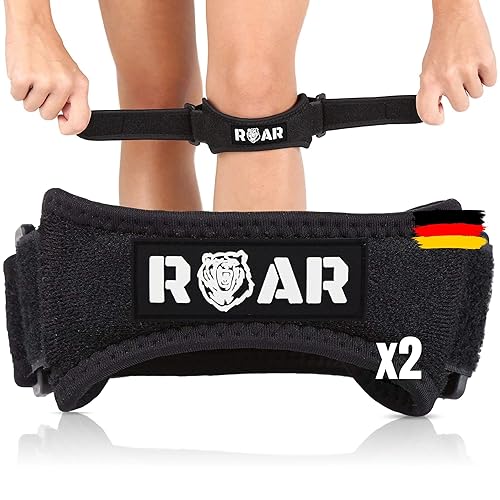
The most minimal option. A focused strap that applies pressure directly to the patellar tendon — that specific pain point just below the kneecap that flares up during jumping, lunging, and quick direction changes. Comes as a 2-pack (both knees or one spare). Minimal bulk, fits under any clothing, barely noticeable during play. The simplicity is the point — if your pain is specifically in the patellar tendon, you don’t need a full sleeve compressing the entire joint. You need targeted pressure in one place. NOT a knee brace — provides zero lateral stability. Only addresses patellar tendon pain specifically. If your pain is above, beside, or behind the knee, this won’t help. Best for: patellar tendonitis, jumper’s knee, players who want the least amount of material on their knee.
- Targeted patellar tendon pressure
- Minimal bulk — barely noticeable during play
- 2-pack included (both knees or spare)
- Most affordable per-unit option
- Simple and effective for its specific purpose
- Zero lateral stability — NOT a knee brace
- Only addresses patellar tendon pain
- Useless for general knee pain or instability
- Strap can shift during intense lateral movement
- Requires correct positioning to be effective
Comfytemp Cooling Cuff Knee

This is NOT a knee support for playing. It is a recovery tool — ice/cold therapy designed for after matches or after a flare-up. The Velcro wrap design conforms to the knee, holding the cooling gel pack in place while you rest. Use it for 15–20 minutes post-match when your knee is hot, swollen, or inflamed. It reduces swelling and pain through cold compression — the same protocol physiotherapists use. Part of the recovery protocol, not the playing protocol. Do NOT wear this on court. Do NOT treat this as a substitute for a knee brace or compression sleeve. Its job starts when you stop playing. Best for: post-match inflammation, acute flare-ups, swelling management. NOT for wearing on court.
- Effective cold therapy for post-match swelling
- Velcro wrap conforms to the knee
- Combines ice and compression in one
- Reusable gel pack — freezer between uses
- Part of a proper recovery protocol
- NOT a playing support — cannot be worn on court
- Does not provide mechanical support
- Requires freezer time between uses (2+ hours)
- Only addresses swelling, not stability
- Often bought by mistake as a playing support
Before and After Match Care
What to do around your knee support — not just during play
Pre-Match and Post-Match Knee Care
Before your match
Wear light compression to warm the joint — a sleeve like the MODVEL or POWERLIX gets blood flowing before you start loading the knee. Follow with a proper dynamic warm-up that includes bodyweight squats, lateral lunges, and leg swings. Some players apply a muscle activation spray on the knee area before play to increase surface warmth and blood flow.
After your match
If swollen: cold therapy for 15–20 minutes (the Comfytemp or a bag of ice). Light compression to manage residual swelling. Gentle mobility work — straight leg raises, heel slides, light quad stretches. If pain is sharp, rest. Do not play through acute knee pain. See our padel recovery guide for the full post-match protocol.
A Knee Support Will Not Fix Your Knee
The honest truth most gear guides won’t tell you
What a Knee Support Can and Cannot Do
What it does
Manages symptoms — reduces pain, swelling, and discomfort during play. Reduces risk by improving proprioception and limiting dangerous movement patterns. Improves confidence — knowing your knee has support changes how you move on court. Enables you to stay active while addressing the root cause.
What it does NOT do
It does not rebuild muscle strength. It does not fix poor movement patterns. It does not replace progressive loading, strength training, or physiotherapy. If you wear a support forever without doing the work underneath, your knee stays weak — it just hurts less while you play.
The actual fix is always strength-based: quad strengthening, hip stability work, progressive loading, and proper recovery. The support buys you time to do that work.
When to see a professional
Sharp pain during activity. Swelling within an hour of playing. Knee giving way or feeling like it will collapse. Locking — the knee gets stuck and won’t straighten or bend. Any of these need professional assessment before you continue playing. See our injury prevention guide for more on when to stop and when to push through.
Knee Support FAQs
The questions padel players ask most
Do knee supports help with padel knee pain?
Yes — for symptom management. Compression improves blood flow and proprioception. Braces limit dangerous movement. Patellar straps reduce tendon stress. But no knee support fixes the root cause. That requires strength training, load management, and proper recovery. A support is an adjunct, not a solution.
Should I wear a knee support all the time?
No. Wearing a knee support continuously risks muscle dependency — the muscles around the knee stop working as hard because the support is doing their job. Wear it during play and remove it afterward. Between sessions, focus on strengthening the muscles that protect the joint.
Compression sleeve vs hinged brace — which do I need?
Compression sleeve for mild soreness, general discomfort, and prevention. Hinged brace for instability — when the knee feels like it might give way, especially after ligament injury. If you’re unsure, start with compression. If it’s not enough, step up to a brace and see a professional.
Patellar strap vs full sleeve — what’s the difference?
A patellar strap applies targeted pressure to the tendon just below the kneecap — it’s specific to patellar tendonitis and jumper’s knee. A full sleeve provides general compression around the entire joint. If your pain is specifically in the patellar tendon, the strap is more targeted. If it’s more general, go with a sleeve.
Can I play padel with knee pain?
It depends on the type. Dull, mild soreness that eases with warm-up: generally safe to play with support and monitoring. Sharp pain, swelling within an hour, or the knee giving way: stop playing and get assessed. Pain is information — don’t mask it with a brace and push through.
When should I see a doctor about my knee?
If your knee gives way or feels like it will collapse. If it locks — gets stuck and won’t bend or straighten. If you have sharp pain during activity. If the knee swells significantly within an hour of playing. Any of these need professional assessment before you continue.
Do I still need to do strength exercises if I wear a knee support?
YES — always. A knee support manages symptoms while you play. Strength training fixes the cause. Quad strengthening, hip stability, progressive loading, and proper recovery are the actual treatment. The support is the bridge that keeps you active while you build that foundation. See our strength training guide for specifics.
Can I wear a knee support while playing padel?
Yes — and most knee supports are specifically designed for active sport use. Compression sleeves fit under any padel shorts and restrict movement minimally. Hinged braces (like the McDavid 429X) are bulkier but provide structural support for instability. Patellar straps (like the Roar) are barely noticeable during play. The key is matching the support type to your need — see our guide above for which type suits which condition.
Does a knee sleeve help with padel knee pain long-term?
A sleeve manages symptoms during play but does not fix the underlying cause. Most padel knee pain comes from hip weakness, quad-hamstring imbalance, or overload from too many matches too quickly. A sleeve reduces discomfort while you play — but without addressing the cause (through strength work and load management), the pain will return. Use the sleeve as part of a rehabilitation plan, not as a permanent solution. See our padel knee pain guide for the full treatment protocol.
What is the best knee support for padel players with patella pain?
For patellar tendon pain (pain just below the kneecap) or patellofemoral syndrome (pain around or under the kneecap), a patellar tendon strap — like the Roar Patella Strap — applies targeted pressure that reduces tendon load during activity. For broader patellar tracking issues, the Zamst RK-1 Plus provides lateral stability to guide kneecap movement. Compression sleeves with a patellar cutout also help by maintaining warmth and reducing swelling without restricting patellar movement.
Protect Your Knees. Build Strength. Stay on Court for Years.
The right knee support reduces pain and risk while you rebuild. Choose based on your issue, pair it with strength work, and play the sport you love — without counting down to when it hurts too much.
See Our Full Knee Pain Guide →
