
In short: Ankle pain in padel usually comes from lateral ankle sprains during those quick lateral movements and court changes. Most cases respond well to rest, ice, and proper ankle strengthening exercises within 2-3 weeks, but wearing an ankle brace while playing prevents re-injury and gets you back on court faster without compromising your game.
PADEL ANKLE PAIN
Explosive direction changes and uneven court surfaces. Ankle sprains are the most common acute injury in padel — and the most preventable.
Answer 3 questions to understand your injury level and what to do next. We’ve found this helps us give you the right guidance for your situation.
In our experience, RICE for 48 hours works well. Gentle range-of-motion after day 2. Return to play when fully pain-free.
What we recommend: 2–4 weeks off court. Proprioception exercises are essential — we’ve seen these prevent re-sprain. Balance board work from day 5 is part of our approach.
Cannot weight-bear normally — possible Grade III sprain or fracture. We know this needs clinical assessment before any activity.
What Is Padel Ankle Pain?
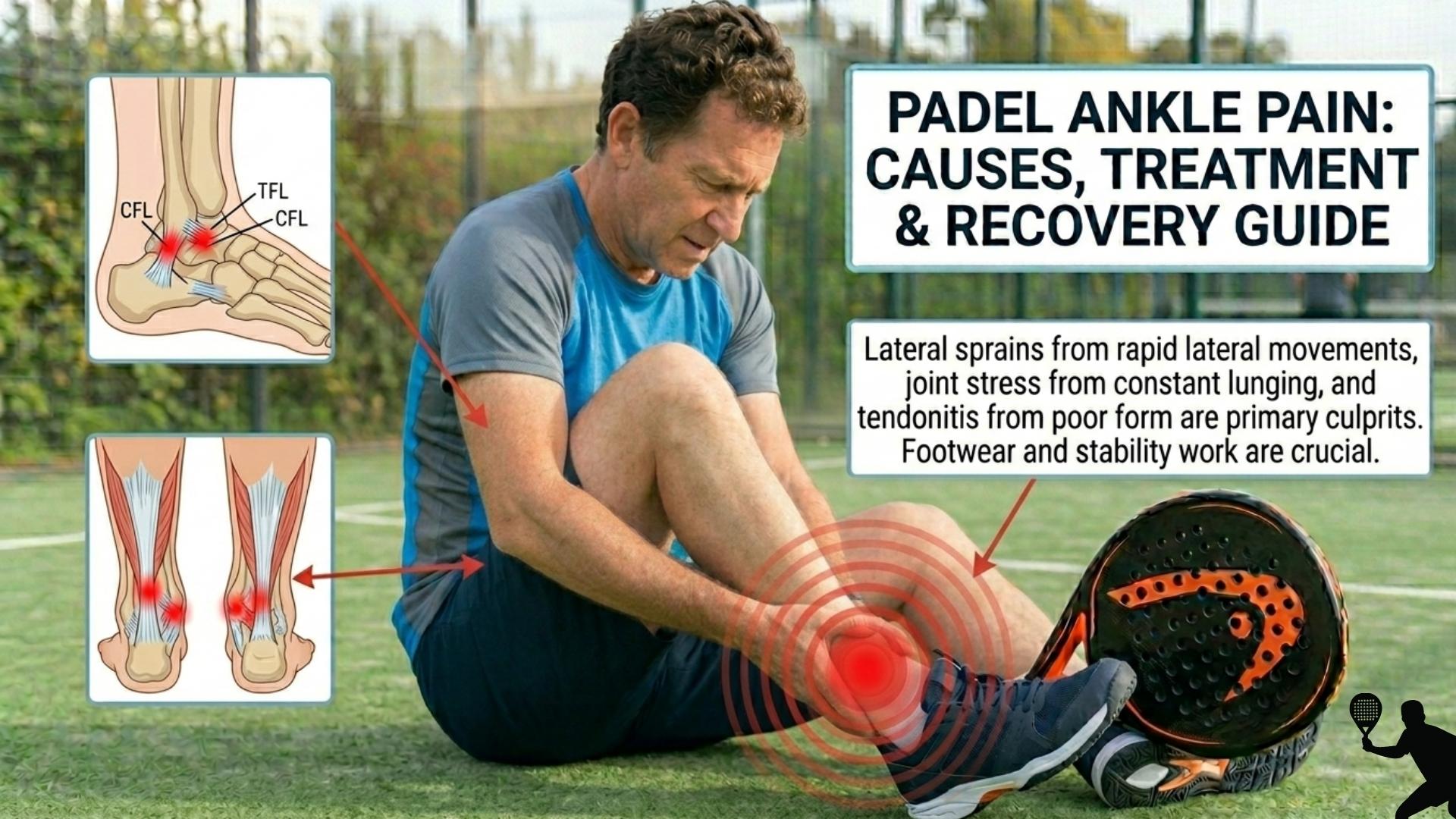
Padel ankle pain almost always involves the lateral ligaments — the bands on the outside of the ankle that stop the foot from rolling inward. When padel demands a sudden lateral cut and your foot lands at a bad angle, those ligaments stretch beyond their normal range. What we see in mild cases is overstretching; in serious cases, partial tears.
Unlike overuse injuries, padel ankle pain usually has a clear moment of onset — the player remembers the exact step that caused it. The issue isn't knowing it happened. The issue is what most players do after, and in our experience, this is where most players go wrong.
They ice it for two days, the swelling goes down, the pain fades, and they're back on court the next weekend. Two weeks later the ankle rolls again in the same spot — because the ligaments are still healing and the surrounding stabilizers were never rebuilt. We've found that without proper rehab, this pattern repeats itself far too often.
What Kind of Ankle Injury Do Most Padel Players Get?
In our experience, the overwhelming majority of padel ankle injuries are lateral ankle sprains — inversion injuries where the ankle rolls outward. This stretches or tears the anterior talofibular ligament (ATFL), the most commonly injured ankle ligament in all sports. What we see on court is that sudden direction changes and landing awkwardly after volleys are the typical mechanisms. The ATFL is at peak risk when the foot is in a plantar-flexed (pointed-down) position during contact with the court surface.
How Long Does Padel Ankle Pain Take to Go Away Completely?
Structural healing (the ligament tissue itself) takes 6–8 weeks for a grade 2 sprain. However, we've found that many players return to court before proprioception and strength are restored — which is why re-sprains are so common in our clinic. Full functional recovery, including the neuromuscular work needed to prevent re-injury, typically takes 8–12 weeks for a moderate sprain. What we recommend is that grade 1 sprains in players who complete rehabilitation properly can resolve in 3–4 weeks.
In plain words
Did a quick turn on the court end in a painful ankle sprain? Let's explore this.
- The outer ankle ligament (ATFL) is the most commonly injured ankle ligament. It is involved in about 70% of all outer ankle sprains (lateral ankle sprains). Source: nih.gov
- If you've sprained your ankle before, proprioceptive training lowers the chance of spraining it again (RR 0.64, 95% CI 0.51-0.81; NNT 13). Source: pmc.ncbi.nlm.nih.gov
- In a study of 187 amateur padel players in Saudi Arabia, 14.97% had sprained an ankle. Source: europepmc.org
- In Saudi Arabia, 75.00% of amateur padel players who had sprained an ankle said they still had trouble moving normally afterwards. Source: europepmc.org
- In Saudi Arabia, 42.86% of amateur padel players who had sprained an ankle went on to sprain it again. Source: europepmc.org
- An ankle sprain happens when the strong ligaments that support your ankle stretch too far and tear. Source: orthoinfo.aaos.org
Easy-read versions of the sourced facts on this topic — written with AI assistance and checked against the wording of each source. Not a substitute for medical advice.
Common Symptoms of Padel Ankle Pain
Padel ankle pain has two presentations. The acute version arrives the moment the ankle rolls — immediate sharp pain, rapid swelling, difficulty weight-bearing. The chronic version creeps in as a nagging instability after a roll that never properly healed.
The most important early sign is a feeling of the ankle giving way on lateral cuts. If you find yourself subconsciously avoiding certain moves, the ligaments are telling you something — long before the pain becomes constant.
Why Padel Players Get Ankle Pain
Sudden injuries almost always have predictable causes
Lateral cuts on wet or uneven surfaces
Padel courts get slippery fast. One bad step on a damp patch or an uneven seam is all it takes for the ankle to fold inward.
Weak lateral ankle stability
The peroneal muscles on the outside of the ankle protect against rolls. If they are not trained with single-leg balance work, they cannot react fast enough when the ankle starts to tip.
Shoes with poor lateral support
Running shoes are built for forward motion, not side cuts. Playing padel in them is one of the most common causes of first-time ankle sprains we see.
Ankle injuries rarely stay isolated. If the calf above has been tight or the foot below has been aching, those are often the same chain — read our guides on calf and Achilles pain and padel foot pain for the full picture.
"Most players roll their ankle, wait two weeks, and go back. The pattern is always the same: they never retrained the stability that would prevent the next one."
Treating Padel Ankle Pain — Phase by Phase
The first 48 hours matter more than any other window
Acute Phase
- Follow the RICE protocol strictly
- Ice 15 min every 2 hours
- Elevation above heart level
- No weight-bearing if it hurts
Sub-Acute Phase
- Start single-leg balance drills
- Ankle alphabet range-of-motion work
- Gentle resistance band rotations
- No cuts, jumps, or padel yet
Return to Play
- Progressive hopping and lateral drills
- Proprioception work on unstable surfaces
- Return to solo drills before matches
- Fix the shoes and court-surface issues
What Recovery Actually Looks Like
Padel ankle pain recovery depends entirely on how severe the sprain is. A grade 1 sprain (mild stretching) can heal in 2–3 weeks. A grade 2 (partial tear) usually takes 4–8 weeks. A grade 3 (full tear) is months and often needs a physiotherapist.
Here are realistic milestones for a grade 1–2 case. Severe sprains with visible deformity or an inability to walk at all need a professional assessment before any of this applies. Also check our general recovery guide for the broader system.
The single most important rule: do not return to padel just because the swelling is gone. Return based on balance and strength — not on how the ankle feels when walking in a straight line.
How to Stop It Coming Back
This is the most important section on the page. Treatment gets you back on court. Prevention is what keeps you there. Padel ankle pain has one of the highest recurrence rates of any injury in the sport — because most players return before the stabilizers are rebuilt.
Real prevention means three things: single-leg balance work twice a week, proper padel-specific shoes (not running trainers), and a warm-up that includes ankle mobility. Do those three and recurrence drops dramatically.
We’ve seen chronic ankle-sprainers go a full season without rolling again just by adding 5 minutes of balance work before every session. No braces. Just the boring consistency nobody else does.
When It Is Time to See a Professional
Most padel ankle pain responds to rest and structured rehab. A few situations need a professional assessment — none of these are emergencies, but they are clear signals to stop self-treating.
- Inability to bear any weight on the ankle at all
- Visible deformity or the joint looking "out of place"
- Severe swelling that does not reduce after 48 hours of RICE
- A popping sound at the moment the injury happened
- Pain that has not improved significantly after 4 weeks
Keep Building the System
The guides that pair best with this one
CLINICAL EVIDENCE
Our recommendations are grounded in peer-reviewed research. Key studies we've drawn from:
- Lateral ankle joint injuries in indoor and court sports: a systematic video analysis — American Journal of Sports Medicine, 2024
- Diagnosis, treatment and prevention of ankle sprains: update of an evidence-based clinical guideline — British Journal of Sports Medicine, 2018
Why Do Padel Ankle Sprains Keep Coming Back?
Because the ligament heals but the ankle's proprioception does not. Proprioception is the ankle's ability to sense its position in space and react before a roll progresses to a sprain. After any ankle sprain, this sensory feedback is disrupted. What we've found is that without rehabilitation exercises specifically targeting balance and reaction, the ankle still cannot protect itself the next time a surface is uneven or a direction change happens too fast. This is why re-injury rates after ankle sprains are so high — 2–3x more likely without proper rehab, regardless of how long you rested.
What Is the Difference Between a Grade 1, 2, and 3 Ankle Sprain?
Grade 1: ligament stretched but not torn. Mild swelling, some pain, able to bear weight. Recovery 1–3 weeks. Grade 2: partial ligament tear. Moderate swelling and bruising, difficulty bearing weight. Recovery 4–8 weeks with structured rehab. Grade 3: complete ligament tear. Significant swelling and bruising, significant instability, often cannot bear weight immediately. Recovery 3–6+ months, sometimes requiring orthopaedic assessment. In our experience, most padel ankle injuries are grade 1 or grade 2. If you cannot bear weight 48 hours after the injury, see a doctor for imaging.
Can Padel Shoes Prevent Ankle Sprains?
Padel-specific shoes significantly reduce ankle sprain risk compared to running shoes or cross-trainers. They have lateral support structures designed for side-to-side movement that running shoes lack entirely. However, no shoe prevents all sprains — a bad landing on a wet surface or a sudden direction change is beyond what any outsole can protect against. What we recommend is a combination of padel-specific shoes plus ankle strengthening and balance training, which offers the best protection. A brace adds another layer for players with a sprain history.
Should You Play Padel With Ankle Pain?
No — and the reason goes beyond just the pain. Playing padel on an incompletely healed ankle significantly increases the chance of a more serious sprain. The ankle is unstable, proprioception is impaired, and the glass court surfaces create sudden, unpredictable direction changes that a weak ankle cannot react to quickly enough. What we see in our team's experience is that the standard return-to-play requirement is single-leg balance of 30+ seconds on the injured side, calf raises equal to the other leg, and ability to complete lateral shuffles without pain. Until those markers are met, the risk of re-injury is real and avoidable.
| What it is | The Anterior Talofibular Ligament (ATFL) is the most frequently injured ligament in the ankle, accounting for approximately 70% of all lateral ankle sprains, either in isolation or with the Calcaneofibular Ligament… (clevelandclinic.org, orthobullets.com, nih.gov) |
| Why padel causes it | Lateral ankle sprains in racket sports like padel typically result from an "inversion injury" where the foot rolls inward, often when the foot is in a plantarflexed position. (e3rehab.com, orthobullets.com, clevelandclinic.org) |
| Main symptom | Common symptoms of an ATFL sprain include sharp pain, swelling, bruising, tenderness over the ATFL, difficulty bearing weight, and a feeling of instability. (clevelandclinic.org, orthobullets.com, nih.gov) |
| Rehab approach | Rehabilitation for ATFL sprains typically follows a phased approach, including an acute/protection phase, a subacute/restoration phase, and an advanced/functional training phase. (e3rehab.com, orthobullets.com, clevelandclinic.org) |
| Returning to play | Return-to-play after an ATFL sprain should be criteria-based, requiring complete absence of pain during all activities, full range of motion, normal strength, restored proprioception/balance, and successful functional… (e3rehab.com, orthobullets.com, clevelandclinic.org) |
| Prevention | Prevention of ATFL sprains involves adequate physical preparation (proprioception, strengthening), appropriate padel-specific footwear, proper warm-up/cool-down, and the use of ankle braces or supports. (e3rehab.com, orthobullets.com, clevelandclinic.org) |
Red-flag signs requiring urgent medical attention include inability to bear weight, severe or uncontrollable pain, visible deformity, numbness/tingling in the foot/toes, or an audible "pop" or "crack" at the time of injury.
Source: clevelandclinic.org, orthobullets.com, nih.gov
Padel Ankle Pain: Frequently Asked Questions
Quick answers to what players ask most
How long does padel ankle pain take to heal?
A grade 1 sprain typically takes 2–3 weeks. A grade 2 takes 4–8 weeks. Grade 3 sprains are months and need professional treatment. Most padel players are dealing with grade 1 or 2.
Can I keep playing with padel ankle pain?
No. Playing on a fresh sprain almost always turns it into a re-injury — and re-injured ankles are chronically unstable. Stop immediately, follow RICE for 48 hours, then the protocol above.
Do I need an ankle brace after a padel sprain?
A brace helps during return to play, especially in the first 6–8 weeks. But it is not a long-term fix. Rebuilding strength and balance is what actually prevents re-injury.
When should I start walking on a sprained ankle?
As soon as you can bear weight without sharp pain — usually 2–4 days after a grade 1 sprain. Gentle weight-bearing speeds recovery. Avoid crutches longer than necessary.
Can padel ankle pain come back after it heals?
Yes, and it frequently does without proper rehab. Once an ankle has been sprained, it is 2–3x more likely to roll again — unless you rebuild strength with balance and mobility work and use proper padel shoes.
How do you tape a sprained ankle for padel?
Rigid sports tape (zinc oxide) provides structural support similar to an ankle brace. Start with anchor strips above and below the ankle. Apply stirrups from the inner lower leg, under the heel, and up the outer leg — these resist inversion. Heel locks go in a figure-of-eight around the heel. Finish with closing strips over the stirrups. For most recreational players, a quality lace-up brace (like the ASO) provides equivalent support with less skill required. Taping is most valuable for competitive players who need a specific feel or are working with a physio.
What exercises rebuild ankle stability after a padel sprain?
Three categories, in progression order. (1) Weight-bearing balance: stand on the injured ankle, eyes open, for 30 seconds. Progress to eyes closed, then on an unstable surface. (2) Calf raises: standing calf raise, progress to single-leg. Eccentric single-leg lowering rebuilds the Achilles-ankle complex most effectively. (3) Reactive drills: lateral shuffles, diagonal changes of direction at increasing speed. The goal is not just strength but reaction time — the ankle must automatically protect itself before a conscious decision can be made.
Is it normal for an ankle sprain to still hurt after 6 weeks?
For grade 1 sprains, 6-week persistence suggests either inadequate rehabilitation (the ligament healed but the ankle is still mechanically weak) or a more significant grade 2 injury than initially recognized. At the 6-week mark, if pain persists during activity and balance is still weaker than the other ankle, see a physiotherapist for reassessment. Occasionally, a previously undetected bone chip or cartilage injury is the reason recovery has stalled — imaging can rule this out.
How is padel ankle pain different from Achilles pain?
Ankle sprain pain (lateral ankle) is typically located on the outside of the ankle at the ligament attachments, peaks acutely at the moment of injury, and has a bruising/swelling pattern. Achilles pain is located at the back of the ankle, where the calf tendon attaches to the heel bone. It builds gradually from overuse, is typically worse in the first steps in the morning and after long matches, and has no acute injury event. They can coexist — an Achilles flare-up after a sprain is common if you compensate for the sprained ankle by loading the calf differently. See our calf and Achilles guide for the Achilles-specific protocol.
When is ankle surgery required for padel players?
Rarely. The vast majority of padel ankle injuries — including grade 3 sprains — heal conservatively with physiotherapy-guided rehabilitation. Surgery (Brostrom procedure or similar lateral ligament reconstruction) is typically considered only when: conservative rehab over 6+ months has not resolved chronic instability, the player has recurring grade 2/3 sprains despite proper rehab, or imaging confirms a loose body or osteochondral defect inside the joint. Most padel players who commit to the full rehabilitation protocol never need surgical intervention.
Play Padel Pain-Free. Trust Your Next Step.
A strong, stable ankle is not about luck — it is about training the stabilizers that catch the foot before it rolls. Five minutes of balance work, proper shoes, and a real warm-up. Start this week and your next cut feels solid for the first time in a long time.
Back to the Treatment Plan ↑Looking for a padel injury specialist in Spain for ankle problems? We manually reviewed 265 clinics — two passed our criteria.
Find a padel injury specialist in Spain →
