
In short: Padel wrist pain usually comes from repetitive racket movements and poor technique rather than one big injury. The key is catching it early—most players ignore mild pain until they can’t play at all. Rest for 3-5 days, ice it down, and focus on your grip pressure and follow-through when you return. Stronger forearms prevent most issues before they start.
PADEL WRIST PAIN
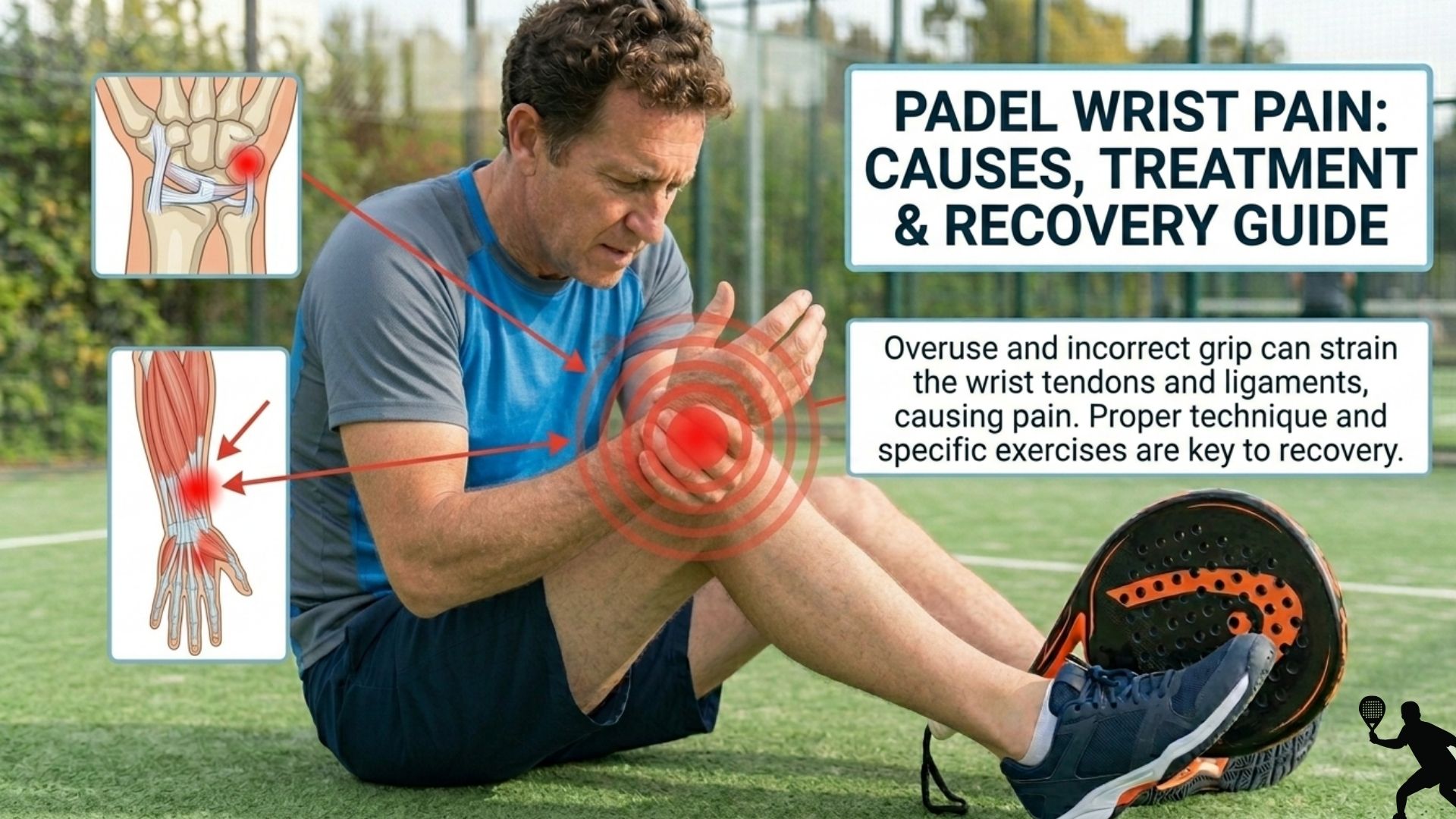
Repetitive impact and excessive grip pressure strain the wrist tendons. Often dismissed as stiffness until it starts affecting your grip mid-rally.
Answer 3 questions to understand your injury level and what we recommend next.
In our experience, grip the racket lower. Rest 5 days from play. We recommend wrist flexor stretches 3× daily.
What we’ve found effective: reduce on-court load 50%. Use a thicker grip. Start a wrist extensor eccentric programme.
Severe pain, swelling, or difficulty gripping may indicate tendon or bone pathology. We know this warrants a physiotherapy assessment before returning.
What Is Padel Wrist Pain?
Padel wrist pain is usually tendinopathy or capsular strain — irritation of the tendons and joint capsule around the wrist. Occasionally it is De Quervain's tenosynovitis, a specific irritation of the thumb-side tendons caused by repeated gripping. What we've found is that all three share the same underlying cause: the wrist is being asked to stabilize more load than the tissues around it can handle.
In padel, the wrist is doing invisible work on every single shot. It absorbs vibration. It adjusts last-millisecond to ball position. It stabilizes the racket under unexpected pressure. In our experience, players never notice it until something hurts.
This is where most players go wrong, and we see it constantly. They assume wrist pain is about the wrist — so they rest it, stretch it, brace it. But what we recommend, and what our team has found time and again, is that the real cause is almost always further up the chain: grip pressure, forearm strength, and sometimes shoulder fatigue transferring load downward.
Pain on the little-finger side of the wrist is a different pattern. Read our guide to ulnar-sided wrist pain in padel.
In plain words
Wrist pain near your thumb making it hard to play? Let's look at De Quervain's.
- With tendon inflammation in your wrist (De Quervain's tenosynovitis), you typically feel pain and tenderness on the thumb side of your wrist, especially over the bony bump (radial styloid process). Source: nih.gov
- An MRI missed a wrist cartilage tear (TFCC tear) in 37.5% of cases. A clear MRI does not rule out a tear. After surgical repair (arthroscopic repair), all 24 returned to their old level, pain dropping from 6.9 to 0.6/10. Source: mdpi.com
- Your padel wrist symptoms are attributed to high-repetition fine racket control, frequent sideways wrist bending (radial/ulnar deviation), and rapid twisting adjustments that raise your total tendon load. Source: mdpi.com
- For tendon inflammation at the thumb side of your wrist (de Quervain tenosynovitis), a steroid injection gives near complete relief in 52% to 90% of patients. Wearing a thumb splint alone offers only temporary relief with high failure and recurrence. Source: ncbi.nlm.nih.gov
- If you injure the cartilage cushion in your wrist (triangular fibrocartilage complex), you will have pain on the pinky side of your wrist. This may come with clicking or pain when pressing a specific spot. Source: ncbi.nlm.nih.gov
- Your padel wrist-hand injuries are overwhelmingly gradual: 81.8% are from overuse rather than sudden. That is the opposite of ankle-foot injuries, where 64.7% are sudden. Source: bmcsportsscimedrehabil.biomedcentral.com
Easy-read versions of the sourced facts on this topic — written with AI assistance and checked against the wording of each source. Not a substitute for medical advice.
Common Symptoms of Padel Wrist Pain
Padel wrist pain almost always starts as a whisper. A small ache after matches. A slight weakness when you reach for a jar. Something that feels a little "off" on a tough volley. Because none of it is dramatic, most players keep playing — and the tendons keep getting more irritated. In our experience, this is where we see the injury take hold.
The biggest early warning sign is grip weakness under pressure. What we've found is that if you find yourself consciously re-gripping mid-point or your volleys feel less precise than usual, the wrist is telling you something well before the pain gets loud. Our team recommends paying close attention to this subtle signal.
Why Padel Players Get Wrist Pain
The three causes behind almost every case
Gripping the racket too tight
Under pressure, most amateur players squeeze the grip harder than needed. That constant tension overloads the small tendons on the thumb side — the same ones that get irritated in De Quervain’s.
Poor contact timing on volleys
When the ball hits the racket late or off-center, the wrist absorbs the vibration the strings should be absorbing. Thousands of bad contacts per match is all it takes.
Weak forearms and shoulders
A weak forearm means the wrist takes more stabilizing load. A tired shoulder means the arm compensates downward. The wrist ends up being the link that breaks first.
Wrist pain almost never stays isolated. It usually travels with forearm tightness that eventually becomes padel elbow, or shows up alongside padel shoulder pain when the whole arm chain is fatigued.
"You know the feeling — that sharp twinge on the backhand that makes you hesitate before every drive. What actually works is two weeks off and six weeks of rebuilding, not just rest."
Treating Padel Wrist Pain — Phase by Phase
Caught early, this is one of the faster injuries to resolve
Acute Phase
- Stop playing — no exceptions
- Ice 15 min, 2x daily if swollen
- Gentle thumb and wrist mobility
- Short-course NSAIDs if needed
Sub-Acute Phase
- Eccentric wrist flexor/extensor work
- Grip strength with a stress ball
- Isometric thumb-side holds
- Shadow swings, no match play
Return to Play
- Progressive light hitting
- Focus on relaxed grip pressure
- Return to solo drills before matches
- Permanent forearm strength habit
What Recovery Actually Looks Like
Padel wrist pain is usually faster to resolve than elbow or shoulder — if caught early. The tendons are smaller, respond well to rest and progressive loading, and the wrist is not under the same gravitational load as larger joints. Most players who stop playing as soon as pain appears are back on court within 4–6 weeks.
The players who take longer are the ones who played through it for weeks before addressing it. Once the tendon becomes chronically irritated, recovery doubles. See our full recovery guide for the broader protocol.
The non-negotiable rule: address grip pressure before you return. If you go back to the same vice-tight grip, the wrist will be back in pain within weeks.
How to Stop It Coming Back
This is the most important section on the page. Treatment gets you back on court. Prevention is what keeps you there. Padel wrist pain almost always recurs unless two things change: how tight you grip the racket, and how strong your forearm becomes.
Real prevention means three habits: a proper forearm warm-up before every match, forearm strengthening twice a week, and a conscious effort to keep grip pressure at maybe 6 out of 10 instead of the usual 9 out of 10 amateurs default to.
We’ve seen players stop recurring wrist pain completely just by learning to relax the grip between points. Free. Just awareness.
When It Is Time to See a Professional
Most padel wrist pain responds well to rest and rehab. A few situations need professional attention — not emergencies, but clear signals that self-treatment is not enough.
- Visible swelling or bruising around the wrist or thumb
- Numbness or tingling in the thumb or fingers
- A clicking or catching that locks the wrist in place
- Pain after a specific fall onto an outstretched hand
- Pain that has not improved after 4 weeks of rest
Keep Building the System
The guides that pair best with this one
CLINICAL EVIDENCE
Our recommendations are grounded in peer-reviewed research. Key studies we've drawn from:
- Sports-related wrist and hand injuries: a review — Journal of Orthopaedic Surgery and Research, 2016
- Incidence, prevalence and nature of injuries in padel: a systematic review — BMJ Open Sport & Exercise Medicine, 2023
Why Does the Backhand Cause Wrist Pain in Padel?
The backhand drive and slice require the wrist to absorb ball impact while already loaded — a pattern that places the wrist flexors and extensors under simultaneous stress. What we see repeatedly in padel is that poor backhand mechanics amplify this: contact made too close to the body forces the wrist into ulnar deviation under load, stressing the triangular fibrocartilage complex (TFCC) on the little-finger side of the wrist. The repetition across a match session turns this mechanical fault into tendon irritation within weeks.
Is Padel Wrist Pain the Same as TFCC Injury?
Not necessarily — but TFCC (triangular fibrocartilage complex) injury is one possible cause of padel wrist pain, particularly pain on the little-finger side of the wrist that worsens with rotation. In our experience, most padel wrist pain is extensor tendinopathy (outer side of wrist and forearm), which responds well to the protocol above. TFCC injuries are more persistent and may require imaging (MRI) to assess properly. If your pain is specifically on the inner-outer side of the wrist with rotation, and has not improved in 4 weeks, we recommend asking for a TFCC assessment.
How Does Grip Pressure Cause Wrist Pain in Padel?
When the overgrip is worn and slippery, the hand involuntarily tightens to maintain racket control. This increases tension in the wrist flexors and extensors simultaneously. When this tightening happens under the shock of ball impact, the combined load on the wrist tendons exceeds normal tolerance. We've found that changing to a fresh tacky overgrip is one of the cheapest and most immediately effective interventions for wrist pain, because it breaks the grip-pressure cycle at its root.
Should I Wear a Wrist Brace While Playing Padel?
A flexible compression brace or wrist wrap is reasonable during the return-to-play phase — it reduces range-of-motion extremes that are painful without preventing functional grip. Rigid splints are for rest only, not for play. We know that for chronic wrist pain, some players find that a thin wrist strap over the joint gives enough proprioceptive feedback to reduce unconscious gripping, which reduces the load on the tendons. No brace fixes the underlying problem — that requires building forearm strength and fixing the grip pressure and technique factors that caused it.
| What it is | Padel wrist symptoms are attributed to high-repetition fine racket control, frequent radial/ulnar deviation and rapid torsional adjustments that raise cumulative tendon load. (mdpi.com) |
| Why padel causes it | Padel wrist symptoms are attributed to high-repetition fine racket control, frequent radial/ulnar deviation and rapid torsional adjustments that raise cumulative tendon load. (mdpi.com) |
| Main symptom | De Quervain's tenosynovitis typically presents with pain and tenderness on the thumb side of the wrist, which worsens with thumb and wrist movements, especially forceful grasping or twisting. (mayoclinic.org) |
| First-line treatment | Conservative treatment for TFCC injury involves rest, activity modification (avoiding axial loading, twisting, ulnar deviation), immobilization via splinting or casting, NSAIDs, ice, and physiotherapy. (aaos.org) |
| Rehab approach | The acute/protection phase of rehabilitation aims to reduce pain and inflammation and protect injured structures through rest, activity modification, splinting, ice, and NSAIDs, with progression criteria being… (physio.co.uk) |
| Returning to play | Return to play for wrist injuries should be criteria-based, requiring pain-free status during all sport-specific movements, full pain-free range of motion, and strength at least 90-95% of the uninjured side. (jospt.org) |
| Prevention | Prevention and load management for wrist conditions involve activity modification, avoiding overuse, proper technique, and gradual progression of load to allow tendons to adapt. (physioadvisor.com.au) |
Red-flag signs requiring urgent medical attention include severe pain immediately after an injury, rapid or excessive swelling and bruising, or visible deformity in the wrist.
Source: aaos.org
Padel Wrist Pain: Frequently Asked Questions
Quick answers to what players ask most
How long does padel wrist pain take to heal?
A mild case typically takes 2–4 weeks with proper rest. Moderate cases take 4–8 weeks. Chronic or ignored cases can stretch into months and usually need a physiotherapist.
Can I play padel with wrist pain?
No. The wrist is doing invisible stabilization work on every shot. Playing through the pain almost always turns a short-term problem into a long-term one.
Does a wrist brace help padel wrist pain?
A brace can help during the acute phase by limiting movement, but it is not a long-term fix. The real answer is building forearm strength and learning to grip with less pressure.
Is padel wrist pain the same as carpal tunnel?
Usually not. Padel wrist pain is tendinopathy. Carpal tunnel is a nerve compression that causes numbness and tingling. If your symptoms include numbness, see a professional.
Can padel wrist pain come back after it heals?
Yes, and it almost always does if grip pressure and forearm strength are not addressed. Our strength training guide covers the forearm work that actually prevents recurrence.
What is the difference between padel wrist pain and padel elbow?
Both involve the forearm extensor chain but at different points. Padel elbow (lateral epicondylitis) is at the tendon's origin at the outer elbow. Padel wrist pain involves the tendons closer to the wrist and hand. The two conditions often coexist — if you have wrist pain, check the outer elbow too. The cause is usually the same (grip pressure and overuse) and the treatment principles are similar, but the specific exercises target different segments of the extensor chain.
Can I use a vibration dampener to reduce padel wrist pain?
Vibration dampeners (placed at the throat of the racket) reduce the high-frequency vibration transmitted to the hand on ball contact. For players whose wrist pain is partly driven by vibration sensitivity, this is a low-cost first intervention worth trying. It does not replace the need for grip pressure reduction and forearm strengthening, but it can reduce aggravation during the return-to-play phase. Choosing a racket frame with a softer feel also helps — rough diamond-pattern frames transmit more vibration than foam-filled round frames.
Is it safe to play padel with a wrist support?
A flexible compression wrap is safe for match play. It reduces extreme wrist positions without limiting grip. Rigid braces are not appropriate for padel — they prevent the natural wrist flexibility needed for shot control and create a false sense of security. The guideline is: if you need more than a flexible wrap to play without pain, your wrist is not ready for full match intensity. Reduce load (drills instead of matches) until you can play comfortably with only light support.
How do I build forearm strength to prevent padel wrist pain?
Two exercises cover most of the prevention: (1) Wrist extension curls: forearm resting on a table, palm down, lower a light weight (0.5-1kg) through wrist flexion and raise through extension. 3 sets of 15 reps. This targets the extensor tendons directly. (2) Forearm pronation-supination: hold a light hammer or dumbbell vertically, rotate slowly from palm-up to palm-down through full range. These exercises should be pain-free. Add them twice a week as ongoing maintenance, not just when you have pain.
When should I get an MRI for padel wrist pain?
MRI is not necessary for most padel wrist cases. It is worth considering if: pain has not improved after 6-8 weeks of proper rehabilitation, pain is specifically on the inner (little-finger) side with rotation (potential TFCC), there was a specific traumatic event at onset, or you have significant weakness in grip or wrist rotation. MRI provides the most detail on soft tissue structures and can identify TFCC tears, tendon ruptures, or bone stress injuries that are not visible on X-ray.
Play Padel Pain-Free. Lighten Your Grip.
A strong, pain-free wrist is not about bracing. It is about two things: a forearm strong enough to take the load, and a grip relaxed enough to let the racket do its job. Build both and every volley feels easier.
Back to the Treatment Plan ↑Need a specialist in Spain for padel wrist injuries? We have reviewed the options so you do not have to.
Find a padel injury specialist in Spain →
