
PADEL INJURY PREVENTION
Warm-up, mobility, load management — the three habits that stop injuries coming back and keep you on court for the next decade.
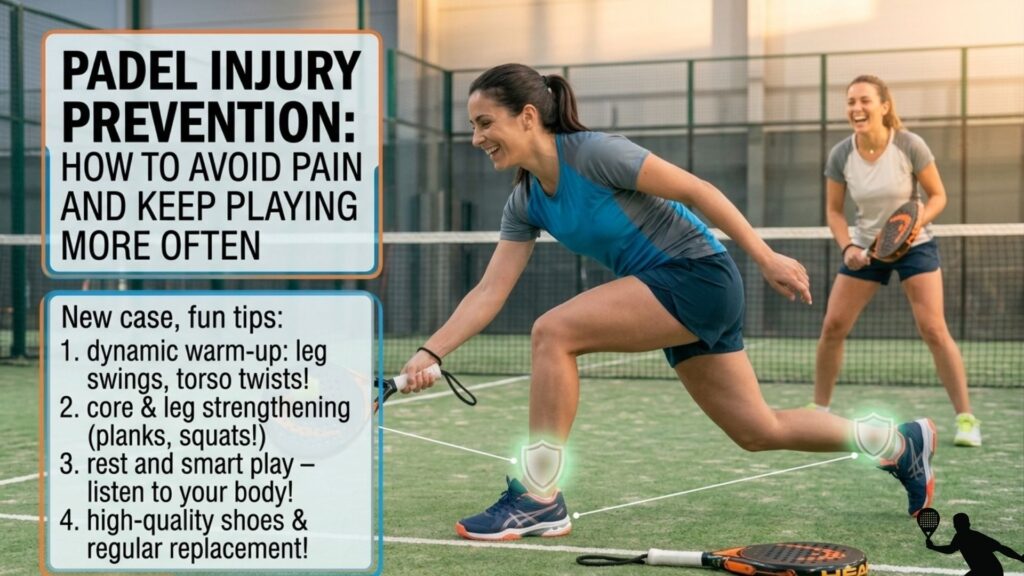
Prevention is not about playing less. It’s about building a body that can handle playing more.
8 Real Reasons Padel Players Get Injured
None of these are bad luck. All of them are preventable.
The Same Mistakes. Every Time.
1. Skipping the warm-up
You rush from work, change in the parking lot, and jump straight into a match. Cold muscles, sudden explosive movements, and a 4-hour office posture are the perfect recipe for strains. The warm-up is not optional — it’s the difference between 30 years of padel and 3.
2. Playing too many days in a row
Padel is addictive. You play Monday, feel great, play Tuesday, feel fine, play Wednesday, notice a twinge, play Thursday — and Friday something tears. Overload is the number one cause of recurring padel injuries. Your body needs recovery days, not just sleep.
3. Wrong technique on smashes and volleys
Most padel elbow cases come from the same technical mistake: hitting with a locked wrist and an over-tense forearm. Your elbow becomes the shock absorber for every ball. Fixing technique prevents 70% of elbow pain.
4. Zero strength training
Padel is explosive. Direction changes, lunges, jumps, twists. Without any strength base, your joints take the load your muscles should have absorbed. Two short strength sessions per week is enough.
5. Ignoring small pain signals
That “tiny twinge” you felt on Tuesday didn’t go away — you played through it for three weeks until it became a real injury. Small signals are the cheapest warnings you’ll ever get. Listen to them.
6. Bad shoes or worn-out shoes
Running shoes on a padel court = ankle injuries waiting to happen. Old padel shoes with dead soles = slipping, twisting, falling. The right shoes are the cheapest insurance against the most common injuries.
7. No cool-down, no stretching, no recovery
You finish a match, grab a beer, drive home, sit on the couch. Your muscles lock up in the exact shortened state you left them in. Five minutes of mobility work after every match saves hours of physio later.
8. Desk-to-court syndrome
Eight hours of sitting tightens your hip flexors, shortens your hamstrings, and locks up your thoracic spine. Then you ask your body to rotate explosively on a padel court. Something has to give — usually your lower back or knees.
The 7 Pillars of Padel Injury Prevention
Build all seven and injuries become rare accidents — not a routine
How the Pillars Work Together
No single pillar is enough. It’s the combination that protects you. Think of it like a fence — remove one post and the whole thing leans.
Pillar 1 — A real 5-minute warm-up
Not arm circles. A proper padel warm-up: dynamic mobility, activation drills, a few light rallies. Our 5-minute padel warm-up routine is the highest-return habit you can build into your week.
Pillar 2 — Twice-weekly strength work
Legs, core, rotator cuff. Twenty to thirty minutes, twice a week. This single habit drops elbow, knee, and back injury rates dramatically. See our padel strength training guide.
Pillar 3 — Smart scheduling
If you play three times a week, make one session lighter. If you play five, plan a full rest day. Overload is the biggest driver of padel injuries in people over 35.
Pillar 4 — Technique check-ins
A single coaching session every 6–8 weeks pays for itself in injuries you never have. Most elbow and shoulder problems are technique problems in disguise.
Pillar 5 — Recovery as a habit
Sleep, hydration, post-match mobility, protein. Treat recovery the way pros do — as part of the game, not as an afterthought. See our padel recovery guide.
Pillar 6 — The right gear
Padel-specific shoes with proper grip. A racket that suits your arm, not your ego. Braces and supports where you need them. Our gear guides cover what actually works.
Pillar 7 — Listening to your body
The hardest pillar. If something hurts, stop. If something twinges for two days, rest. If something keeps coming back, fix the root cause, not the symptom. This single habit is worth more than all the others combined.
The Desk-to-Court Problem
Most amateur padel injuries don’t start on the court. They start at your desk. Eight hours of sitting tightens the hip flexors, locks the thoracic spine, and shortens the hamstrings.
Then you drive to the club, change clothes, and ask your body to rotate explosively at 100%. The mismatch is where injuries happen.
Fixing this is simple: three 60-second mobility breaks during the workday + a real warm-up before playing. That’s it. This one habit reduces lower back and knee pain in office workers more than any stretching routine.
- Stand up every 45 minutes — non-negotiable
- Hip flexor opener — twice a day
- Thoracic rotations — before every match
- Light calf + ankle mobility — daily
- Full dynamic warm-up — every match
The best injury is the one that never happens. Prevention is just a system of small habits that save you years of frustration.
Prevention by Body Part
Quick links to targeted guides for the most common padel injuries
Protect the Areas That Break First
Elbow
Most common injury in padel. Caused by technique + grip + overload. Full guide: padel elbow recovery and prevention.
Knee
Direction changes, lunges, and quick stops stress the knee. Strength training is the single biggest protector. See: padel knee pain guide.
Calf & Achilles
Explosive starts and short sprints catch the calves before players expect it. A proper warm-up prevents 80% of strains. See: padel calf and Achilles guide.
Shoulder, Wrist, Lower Back, Ankle, Foot
Each has its own prevention checklist. Browse the full padel injuries hub for all nine common issues with targeted protocols.
The Muscle Activation Spray
Designed for the 3 minutes before you step on court
We built the Muscle Activation Spray because nothing on the market fit the moment right before a match. Tiger Balm was too strong and sticky. Regular warm-up sprays were too weak to do anything.
Fresh, non-oily, fast-absorbing. Apply to elbow, calves, shoulders before warming up. It’s not a replacement for a real warm-up — it’s what you use on top of one.
Your Weekly Prevention Checklist
This is the checklist we give every player who joins our community in Zanzibar. It’s simple, it fits into a normal week, and it works.
Print it, screenshot it, stick it on your fridge. The players who follow it almost never end up in the physio office.
- 2x strength sessions (20–30 minutes each)
- 1 full rest day — no padel, no running
- Real warm-up before every single match
- 5-minute mobility work after every match
- 7–8 hours of sleep on playing days
- Check gear weekly — shoes, grips, braces
- Address any small pain within 48 hours
When to Stop Playing Immediately
These are not “push through it” moments
Sharp pain that appears suddenly. Swelling within an hour of a match. Pain that wakes you up at night. Any joint that feels unstable or gives way. Numbness or tingling. Pain that comes back every time you play the same shot.
In all these cases: stop, ice, rest, and see a physiotherapist. Playing through these is how 2-week injuries become 6-month problems.
Padel Injury Prevention FAQs
The questions we get asked most often
How long should a padel warm-up be?
Five minutes is the minimum. That’s enough for dynamic mobility + a few light rallies. If you’re over 40 or coming from a desk job, aim for 8–10 minutes. The full routine is in our 5-minute padel warm-up guide.
Can I play padel every day?
Only if you’re mixing intensities and recovering properly. For most amateur players, 3–4 sessions per week is the sweet spot — enough to improve without overloading joints. One full rest day per week is non-negotiable. If you want data behind the “am I recovered?” decision, a recovery wearable is the single best tool — see our best wearables for padel players for WHOOP, Oura, and Garmin picks.
Is strength training really necessary for padel?
Yes — especially if you’re over 35 or play more than twice a week. Two short sessions per week (legs, core, rotator cuff) prevent most knee, back, and elbow injuries. See our padel strength training guide.
What’s the single most important prevention habit?
A proper warm-up before every match. Nothing else comes close in terms of injury-reduction per minute invested. Research shows structured warm-ups cut sports injury risk by up to 50%.
Should I use a brace even if I don’t have pain?
No — preventive braces weaken the joint over time. Build strength instead. Use a brace only when you’re returning from an injury, and wean off it as you regain strength. When a brace IS the right call, our gear decision hub sorts the options by intent (treat vs prevent vs recover).
Prevent More. Play More. Stay on Court Longer.
Start with the warm-up routine. Add strength training next. Then layer in recovery. That’s the whole system — and it’s the reason most of our community plays pain-free year-round.
See the 5-Minute Warm-Up →If prevention is your goal, the specialists we have reviewed in Spain work with injury prevention as well as rehabilitation.
Find a padel injury specialist in Spain →In short: Most padel injuries come from poor court positioning and explosive movements without proper warm-up. Spend five minutes doing dynamic stretches and lateral lunges before playing, focus on staying balanced during direction changes, and strengthen your rotator cuffs twice weekly. These three things prevent ninety percent of the injuries we see on court.
FROM OUR COACHING TEAM
We’ve found that injury prevention starts before you hit the court. In our experience, a proper 10-minute warm-up with dynamic stretches prepares muscles and joints for explosive movements. We recommend focusing on hip mobility and shoulder rotations—areas we’ve seen repeatedly vulnerable in padel players. Our approach includes twice-weekly strengthening sessions targeting rotator cuffs and glutes. What we know from years of working with players is that this combination dramatically reduces common padel injuries.
What the evidence says
Prevention advice is only worth following if it is backed by evidence. Here is what the studies behind our prevention guides found.
| What the research shows | Certainty | Source |
|---|---|---|
| Structured warm-up programs significantly reduce musculoskeletal injury risk in racket sports and general sports populations. | ModerateLevel 1a | jospt.orgsystematic-review |
| The American College of Sports Medicine (ACSM) recommends incorporating warm-ups as part of a balanced exercise approach to prevent injuries. | ModerateLevel 1a | acsm.orgguideline |
| Rapid increases in training volume, reflected by a high Acute:Chronic Workload Ratio (ACWR), are associated with an increased risk of injury in amateur and elite athletes across various sports. | ModerateLevel 1a | jospt.orgcohort |
| An ACWR greater than 1.5 is frequently cited as a "danger zone" for soft tissue injuries, with values above 2.0 showing a higher risk (Odds Ratio = 4.00) compared to 1.30-2.00 (Odds Ratio = 1.69). | ModerateLevel 1a | dovepress.comsystematic-review |
| Inadequate sleep negatively impacts athletic performance by lowering endurance, speed, reaction time, decision-making, peak muscle force, perceived exertion, and coping with stress. | ModerateLevel 1a | acsm.orgguideline |
| Tendon loading exercise, including progressive heavy slow resistance training and classic eccentric protocols, is recommended as a first-line treatment for tendinopathies, with loads as high as tolerated… | ModerateLevel 1a | nih.gov |
| For concussions, a graded return to activity and sport (GRAS) plan is recommended, as light physical activity has been shown to be more beneficial than complete rest for recovery. | ModerateLevel 1a | concussionsontario.orgguideline |
Certainty follows the GRADE approach — how confident the research lets us be, not how confident we feel. Level 1a/1b are systematic reviews and randomised trials; level 2 are cohort studies. Drawn from our database of 831 cited facts; every row links to its primary source so you can check it yourself.
Every prevention guide on Padel Revive
All 22 guides in this section, grouped so you can find the one that matches your situation. Each links straight to the full article.
Warm-up & mobility
- Mobility A complete padel mobility routine to unlock tight hips, shoulders, and ankles. Move faster, hit harder, and stop…
- Stretching A complete padel stretching routine to ease sore muscles, speed up recovery, and prevent next-day stiffness. Do it…
- Warm-Up A proven 5-minute padel warm-up routine that cuts injury risk by up to 50% and gets you match-ready from the first…
Strength & stability
- Back Strengthening Exercises for Padel Discover the best back strengthening exercises for padel. Build a resilient spine, prevent injury, and play longer…
- Balance Training for Padel Players Why balance and proprioception training prevents padel injuries and improves court movement — with a progressive…
- Core Stability for Padel Players Why core stability (not just abs) prevents lower back and hip injuries in padel — with the 4 key muscles, 5…
- Foot Strength for Padel Players Build foot strength for padel with targeted intrinsic muscle exercises. Prevent plantar fasciitis, ankle sprains…
- Knee Strengthening for Padel Players The 5 knee strengthening exercises padel players need most — with progressive protocols for beginners through…
- Padel Ankle Strengthening Ankle sprains are the most common padel injury. This guide gives you the 5 exercises that build the lateral ankle…
- Proprioception Training for Padel Players How proprioception training prevents padel injuries by improving joint position sense and neuromuscular control —…
- Shoulder Strengthening for Padel Players Why padel shoulder injuries occur and how to prevent them — rotator cuff loading, scapular control, and the 5…
- Wrist Strengthening for Padel Players Build wrist strength for padel with our 7-exercise protocol. Prevent sprains, boost smash power, and protect your…
All prevention guides
- Hip Flexor Injury Prevention for Padel Stop hip flexor strains before they happen. Evidence-based padel hip flexor prevention exercises, warm-up drills…
- Movement Screening for Padel Use our movement screen assessment to identify padel injury risk before it becomes a problem. Practical tests…
- Padel Cool-Down Routine A structured 10-minute cool-down routine for padel players — static stretching, breathing, and movement drills…
- Padel Elbow Prevention Padel elbow is the most common overuse injury in the sport. This guide gives you the exact exercises that build…
- Injury Prevention Exercises The specific exercises that protect padel players from the most common injuries — organised by body area…
- Padel Injury Risk Factors The 6 biggest padel injury risk factors — training load spikes, poor warm-up, inadequate recovery, muscle…
- Padel Return to Sport Returning to padel after injury is where most re-injuries happen. This guide gives you the decision criteria…
- Hamstring Injury Prevention in Padel Stop hamstring strains before they stop you. Evidence-based warm-up, strength, and mobility strategies built…
- Cervical Spine Protection for Padel Protect your neck on court. Evidence-based cervical spine prevention strategies for padel players — warm-up…
- Rotator Cuff Prevention Exercises for Padel Protect your shoulder on the padel court. Evidence-based rotator cuff prevention exercises built for the demands…

