
In short: Lower back pain in padel usually comes from explosive rotational movements and poor court positioning forcing you to overreach. The best fix isn’t rest—it’s strengthening your core and glutes so your spine doesn’t do all the work during those quick lateral shots. Most players see improvement in two weeks with proper conditioning.
PADEL LOWER BACK PAIN
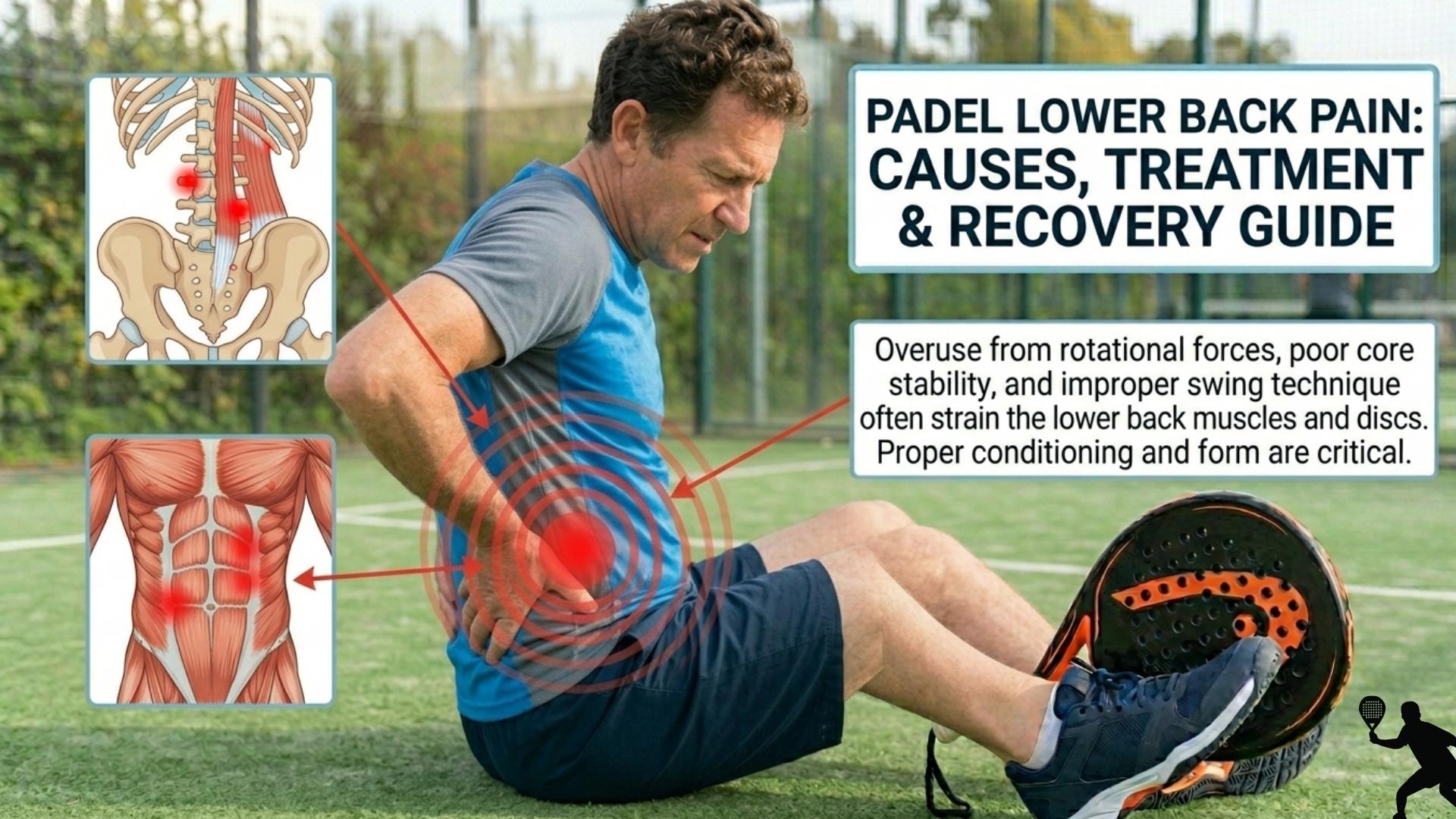
Rotation, poor posture, and weak core muscles overload the lumbar spine. The most common chronic complaint in padel players over 35.
Answer 3 questions to understand your injury level and what to do next.
Rest 2 days. Avoid heavy rotation. Start McKenzie extensions and hip flexor stretching.
Avoid padel for 2 weeks. Daily lumbar mobility work. Core activation: dead bugs, bird dogs.
Sharp radiating pain, numbness, or leg weakness suggest nerve involvement. Needs physiotherapy or medical review before returning.
What Is Padel Lower Back Pain?
Padel lower back pain usually involves irritated muscles and connective tissue in the lumbar region — not injured discs or nerves. In our experience, the specific structure that hurts depends on the player: sometimes it is the quadratus lumborum pulling tight on one side from asymmetric rotation, sometimes it is the facet joints compressing under repeated extension, sometimes it is just exhausted spinal erectors trying to stabilize a trunk that has nothing supporting it.
The common thread — and we've found this to be true across hundreds of players we've worked with — is that the spine is doing work the hips and core should be doing. Padel demands fast rotation on almost every shot. If the hips can't rotate because they're stiff from sitting at a desk all day, the lower back rotates instead. Do that, and something eventually gives.
This is where we see most players go wrong. They stretch the back, foam-roll the back, ice the back — and get temporary relief that never lasts. What we recommend instead is understanding that the real fix is almost never the back itself.
In plain words
Did bending for that low ball upset your lower back? Let's talk about lower back pain.
- Lower back pain is very common. Source: nhs.uk
- Back pain usually improves within a few weeks but can sometimes last longer or keep coming back. Source: nhs.uk
- A common cause of back pain is an injury like a pulled muscle (strain). Source: nhs.uk
- Sometimes, medical conditions like a slipped disc, a trapped nerve (sciatica), or inflammatory spine arthritis (ankylosing spondylitis) can cause back pain. Source: nhs.uk
- Very rarely, back pain can be a sign of a serious problem like a broken bone, cancer, or an infection. Source: nhs.uk
- With back pain, stay active and try to continue with your daily activities. Source: nhs.uk
Easy-read versions of the sourced facts on this topic — written with AI assistance and checked against the wording of each source. Not a substitute for medical advice.
Common Symptoms of Padel Lower Back Pain
Padel lower back pain almost always builds up — rarely from one bad shot. In our experience, it starts as morning stiffness that eases with movement, then becomes a tight pull on rotation shots, then a constant ache that lingers the day after matches, then the thing you feel every single time you twist.
The warning sign we've found most players ignore is asymmetry. If one side feels tighter than the other, or if your bandeja feels worse than your forehand, the spine is already compensating for something — usually a stiff hip or a weak glute on the same side. What we see repeatedly is that addressing this asymmetry early makes all the difference.
Why Padel Players Get Lower Back Pain
The three causes behind almost every case
Stiff hips from sitting
Desk work locks the hips. When the hips can’t rotate on a bandeja or forehand, the lower back rotates instead — and the lower back is not built for it.
Weak core, especially the obliques
The core’s job is to transfer force from legs to arms. When it’s weak, the spine stabilizes instead. Thousands of rotations a match and something has to give.
Arrival-then-play with zero warm-up
Getting out of the car, grabbing a racket, and going straight into a match with a cold, stiff body is the single most common pattern we see before a back pull.
Lower back pain rarely travels alone. If your hips have been tight or you’ve noticed shoulder stiffness on overheads, those are usually the same chain — see our guides on padel shoulder pain and padel knee pain for the full picture.
"Most players rest, get better, go back, and repeat. The pattern kept repeating until we realised it was never a back problem — it was always a hip and strength problem."
Treating Padel Lower Back Pain — Phase by Phase
The goal is never just pain relief — it is rebuilding the chain
Acute Phase
- Stop matches — no rotation shots
- Heat for chronic stiffness, ice if sharp
- Gentle walking, not bed rest
- Short-course NSAIDs if needed
Sub-Acute Phase
- Dead bugs and bird dogs daily
- Hip mobility work every single day
- Glute bridges and side planks
- No bandejas or smashes yet
Return to Play
- Progressive rotation drills
- Strength work for the full core
- Return to matches: 1 a week first
- Permanent mobility + warm-up habits
What Recovery Actually Looks Like
Padel lower back pain recovery depends on what you fix — not just how much you rest. We've seen players who only rest feel better and are back in pain within a month. The players we work with who address the underlying stiffness and weakness take longer initially but stay pain-free for years.
Here are realistic milestones for a mild to moderate case based on what we recommend. Sharp radiating pain, numbness down the leg, or any loss of bladder/bowel control are emergencies and need immediate medical care. Also see our general recovery guide.
Non-negotiable rule in our approach: do not return to matches based on how the back feels. Return based on rotation range and core strength — two things that are easy to test and almost always lag behind how you subjectively feel. We've found this to be the most reliable marker for safe return to play.
How to Stop It Coming Back
This is the most important section on the page. Treatment gets you back on court. Prevention is what keeps you there. Padel lower back pain has one of the highest recurrence rates in the sport — almost entirely because players keep doing the same thing that caused it in the first place.
Real prevention means three things: daily hip mobility (not once a week), a real warm-up that includes rotation prep, and twice-weekly core work that actually trains anti-rotation and anti-extension — not just crunches.
We’ve seen players with years of recurring padel back pain go without a single flare-up just by committing to hip mobility daily. No surgery. No injections. Just consistency where it counts.
When It Is Time to See a Professional
Most padel lower back pain responds well to the protocol above. A few red flags need immediate professional attention — some are emergencies. Do not self-treat any of these.
- Numbness, tingling, or weakness that travels down a leg
- Any loss of bladder or bowel control (medical emergency)
- Severe pain after a specific fall or impact
- Pain so bad it prevents sleep or walking
Keep Building the System
The guides that pair best with this one
CLINICAL EVIDENCE
Our recommendations are grounded in peer-reviewed research. Key studies we've drawn from:
- Lumbar loading in the elite adolescent tennis serve: link to low back pain — Medicine & Science in Sports & Exercise, 2013
- Repetitive traumatic discopathy in the modern-era tennis player — Sports Health, 2020
Why Does Rotation Cause Lower Back Pain in Padel?
Padel is a rotational sport — almost every shot requires the trunk to rotate while the feet are planted or in lateral motion. What we've found is that when the hips are stiff and cannot contribute enough rotation for a shot, the lumbar spine is forced to compensate. The lumbar vertebrae are designed for flexion and extension, not rotation — repeated rotational stress on restricted lumbar joints, particularly under load, creates the disc irritation and facet joint compression that most players experience as "back pain after padel." In our experience, improving hip rotation range reduces this transfer of rotational demand to the lower back significantly.
Is Padel Lower Back Pain the Same as a Disc Problem?
Not in most cases. We know that the majority of padel lower back pain is muscular or facet joint irritation, not a disc herniation. Disc problems typically produce radiating pain down one or both legs (sciatica), weakness in the leg or foot, or significant pain bending forward. If your pain stays in the lower back and buttock area, is worse on rotation and extension, and eases with rest, it is more likely muscular or joint-related. Radiating leg pain, pins and needles, or foot weakness are red flags that require medical imaging before any exercise programme.
Why Does Sitting at a Desk All Day Make Padel Back Pain Worse?
Prolonged sitting shortens the hip flexors and compresses the lumbar discs. After desk work, the hip flexors are in a shortened position that tilts the pelvis forward, increases lumbar lordosis, and pre-loads the lower back before the match even starts. Then you arrive on court, skip the warm-up, and immediately start rotating your stiffened spine through full match intensity. What we see clinically is that the desk worker who plays evening padel is the most predictable lower back pain patient in sports medicine. The fix is decompression (hip mobility) before every session, not after.
Can Core Training Prevent Padel Lower Back Pain?
Yes — but only the right kind of core training. Traditional sit-ups and crunches increase lumbar compression and are counterproductive for padel back pain. Our approach to core training that protects the lower back in padel is anti-rotation stability: planks, dead bugs, Pallof press, and bird-dogs. These train the core to resist the rotational forces that padel generates, rather than just moving through flexion. A 10-minute anti-rotation core routine twice a week is one of the most evidence-supported padel lower back prevention interventions available.
| What it is | Non-specific mechanical low back pain (NSMLBP) in padel players typically involves irritation or strain of lumbar muscles (e.g., quadratus lumborum, spinal erectors), ligaments, facet joints, and intervertebral discs. |
| Why padel causes it | NSMLBP in padel players often arises from explosive rotational movements, poor court positioning, overreaching, weak core/gluteal muscles, stiff hips, and repetitive flexion/extension/rotation, which collectively stress… |
| Main symptom | Padel-related NSMLBP usually develops gradually, presenting with morning stiffness, tightness or ache during/after rotational shots, constant ache, asymmetry, and localized pain in the lower back/buttock that worsens… |
| First-line treatment | First-line conservative treatment for NSMLBP includes patient education, encouraging activity, short-term NSAIDs, acetaminophen, muscle relaxants, superficial heat, exercise-based rehabilitation (McKenzie Method, spine… (aafp.org, sabahealth.co.uk, physio-network.com) |
| Rehab approach | Rehabilitation for NSMLBP typically progresses through acute (pain management, movement restoration), subacute/strengthening (flexibility, trunk/hip strength, movement control), and return to sport/advanced training… |
| Returning to play | Return-to-play for NSMLBP is criteria-based, requiring pain-free status, functional mobility, normal trunk and hip range of motion, near-normal muscle strength/endurance… |
| Prevention | Prevention of NSMLBP in padel involves a multi-faceted approach including structured warm-up/cool-down, strength training (core, gluteal, hip), flexibility/mobility, proper technique, gradual load management, suitable… |
Red-flag signs for low back pain requiring urgent referral include severe/progressive pain, new neurological deficits (numbness, tingling, weakness), loss of bowel/bladder control, saddle anesthesia, fever/signs of infection, unexplained weight loss, history of cancer, recent trauma, atypical pain (night pain, unrelenting), and pain in persons younger than 18 or older than 50 with other red flags.
Source: carterpt.com, osistl.com, aafp.org
Padel Lower Back Pain: Frequently Asked Questions
Quick answers to what players ask most
How long does padel lower back pain take to heal?
Chronic cases almost always need mobility and strength work — not just rest.
Should I rest or stay active with padel lower back pain?
Active recovery wins. Complete bed rest actually makes lower back pain worse. Gentle walking, hip mobility, and core work all help — matches and twisting do not.
Is stretching enough to fix padel lower back pain?
Rarely. Most padel lower back pain comes from weakness and stiffness elsewhere — hips and core. Stretching the back feels good but doesn’t fix the root cause. A mobility routine plus core strength is the real answer.
Can I play padel with lower back pain?
Not until you’ve had a few weeks pain-free with basic mobility back. Playing through it turns a 3-week problem into a 3-month one. Every time.
Why does my lower back always lock up the morning after padel?
Usually hip stiffness plus inadequate warm-up. Your spine did more work during the match than it should have, and the morning stiffness is the muscles around it trying to protect it. Fix the hips and the morning stiffness usually disappears.
What is the fastest way to get rid of padel lower back pain?
For acute pain: relative rest (reduce intensity, avoid twisting), then gentle movement as soon as tolerable. Hip flexor stretching and cat-cow mobility exercises start from day 2. The fastest route to resolution is restoring hip mobility and reactivating the core — not passive rest. Most acute padel lower back cases resolve with this approach. Longer duration usually means the hip and core component was not properly addressed.
Is lower back pain after padel normal?
Common, yes. Normal, no. The fact that many padel players experience back pain does not mean it is an inevitable consequence of the sport. It is a consistent signal that something in the chain — usually hip mobility or core stability — is insufficient for the rotational demand. Players who maintain a proper warm-up, work on hip mobility regularly, and do anti-rotation core training rarely develop chronic lower back pain from padel, regardless of how often they play.
Can padel lower back pain cause leg pain?
When lower back irritation involves the lumbar nerve roots — from disc compression, joint inflammation, or muscle spasm — pain can radiate into the buttock, hip, or down the leg (sciatica). If you have leg pain alongside back pain, assess whether it goes past the knee and whether it includes any tingling, numbness, or weakness. Pain only in the buttock and upper thigh is usually referred muscle pain. Pain below the knee with neurological symptoms (tingling, weakness) suggests nerve involvement and needs medical assessment before any exercise programme.
How long should I wait before returning to padel after lower back pain?
The return-to-play marker for lower back pain is functional, not time-based. You should be able to: walk pain-free, rotate the trunk through normal range without pain, and do hip mobility exercises pain-free. Then start with gentle solo drill sessions before returning to match play. The mistake is returning as soon as the acute pain fades — that is before hip and core function are restored, which means the next match loads the exact same unprepared structures.
Does padel lower back pain need physiotherapy?
Not in every case, but often yes for anything beyond a mild single-episode. A physiotherapist can identify whether the pain source is muscular, joint-related, or neurological, and prescribe a specific rehabilitation programme for your movement pattern and weaknesses. For players with recurring padel lower back pain — it keeps coming back after every tournament or intensive block — a single physiotherapy assessment is usually the most efficient path to a permanent fix. Self-treatment works for mild cases; professional guidance significantly improves outcomes for chronic or recurring ones.
Play Padel Pain-Free. Unlock Your Hips First.
A strong, mobile back is almost always about everything else working properly. Fix the hips, build the core, warm up every time. Do that and the next smash feels free for the first time in a long time.
Back to the Treatment Plan ↑If you are dealing with lower back pain from padel and want specialist support in Spain, we have vetted the options.
Find a padel injury specialist in Spain →
