
Padel Shoes vs Tennis ShoesWhat Is the Difference?
Why the outsole pattern determines your injury risk — and when you can safely substitute one for the other.
Primary difference — outsole tread pattern for surface type
Shoe types compared — padel, hard court, clay, grass, running
Injury risks — ankle sprain, knee stress, plantar fasciitis
In short: the critical difference is the outsole. Padel courts use artificial grass, which demands a fishbone/herringbone tread for lateral grip. Hard court tennis shoes have durability-focused outsoles with no lateral grip on artificial grass. Running shoes are completely wrong for padel and substantially increase ankle sprain risk.
How we picked: we researched manufacturer specifications, retailer listings and specialist reviews. We did not test these products ourselves, and where a detail could not be confirmed we say so. Last updated: 11 Oct 2026.
As an Amazon Associate I earn from qualifying purchases. Links marked Ad are affiliate links. A price marked “Street price” is the price on the named retailer’s own product page on the date stated beside it; it is not Amazon’s price and not the manufacturer’s RRP, and it may have changed.
Court Surfaces: Where the Difference Starts
Padel Courts
Artificial grass (most common) or sand-infilled artificial grass. Requires a fishbone/herringbone tread that grips the fibres without catching during pivots. Surface allows controlled lateral slide.
Hard Court Tennis
Asphalt or concrete with acrylic coating. Abrasive and unforgiving. Requires a durable outsole designed for braking during forward and backward running — not lateral change-of-direction.
Clay Court Tennis
Crushed brick or clay. Slippery surface that requires a herringbone tread with deeper grooves to channel clay away and provide grip. Closest outsole relative to padel shoes.
Grass Court Tennis
Natural grass. Requires small pimple/stud pattern that bites into the turf without tearing it. Completely inappropriate for padel courts.
Outsole Patterns: The Technical Explanation
Padel Shoes: Fishbone / Herringbone Tread
Hard Court Tennis Shoes: Durability Outsoles
Lateral Stability: Why Padel Is Different from Running
How padel shoes are engineered for lateral loads
Padel shoes use a reinforced lateral edge — a harder, more supportive material along the outer edge of the midsole and upper that resists the inward buckling that occurs during explosive lateral deceleration.
The base width of padel shoes is typically wider than running shoes to increase the base of support during lateral cuts, reducing the torque transferred to the ankle during sudden directional changes.
Many padel shoes also include a reinforced toe cap to protect the toe box during the forehand return stance, where players frequently drag the leading foot.
- Reinforced lateral edge midsole
- Wider base for lateral stability
- Toe cap reinforcement for drag protection
- Purpose-built herringbone outsole for artificial grass
- Midsole cushioning tuned for lateral impact, not heel-strike running
Running shoes are engineered entirely for forward-motion heel-to-toe loading. They have narrow bases, soft laterally compliant midsoles, and forward-direction tread patterns. Wearing running shoes for padel provides: (1) no lateral grip on artificial grass, (2) no lateral midsole support during direction changes, and (3) a narrow base that increases ankle inversion during lateral cuts. This is the combination most associated with acute lateral ankle sprains on the padel court.
The Practical Substitution Guide
Can you use clay court tennis shoes for padel?
Can you use padel shoes for tennis?
Padel shoes on different tennis surfaces
You know the feeling — you borrow a pair of trainers for a session, think nothing of it, and roll your ankle on the first hard lateral cut. Most players don’t realise that what actually works to prevent that is the outsole pattern, not just ankle strength. The right shoe is the first line of defence on the padel court.
Injury Risk: What Happens When You Wear the Wrong Shoe
Ankle Sprain
The most common consequence of incorrect outsole selection. Lateral slip on artificial grass during a direction change — caused by inadequate herringbone grip — leads to uncontrolled ankle inversion. The lateral ankle ligaments (ATFL and CFL) are the structures at risk.
Knee Stress
A shoe without adequate lateral support places higher rotational stress on the knee during direction changes. The knee is not designed to absorb lateral torque — the foot and ankle are the primary dissipation point. When shoe construction fails to manage lateral loads, those forces transfer proximally to the knee.
Plantar Fasciitis
Running shoes have arch support and cushioning engineered for the repetitive heel-strike of forward running. On a padel court, the forefoot loading pattern during lateral cuts and split steps is different. Running shoe arch geometry can create abnormal loading of the plantar fascia during padel movement patterns, particularly during the forehand return stance.
The Recommendation: Invest in Purpose-Built Padel Shoes
Padel-Specific Shoes We Recommend
ASICS GEL-Resolution X Padel

The Resolution X is the shoe we’d recommend if someone asked “just tell me what to buy.” It’s not the lightest. It’s not the flashiest. It does everything at a high level without a significant weakness. The GEL cushioning system absorbs impact on hard courts better than any foam-only midsole we’ve tested. The herringbone outsole grips both indoor and outdoor surfaces. The upper is reinforced in the toe and medial side — which is where padel shoes die first on most other brands. We’ve used ASICS extensively and they’re among the best padel shoes available. One honest note: they can feel slightly narrow if you have very flat or wide feet. If that’s you, try a half size up or pair them with custom insoles.
- Excellent all-round performance
- GEL cushioning reduces joint stress
- Durable construction — lasts longer than most competitors
- Strong lateral stability for direction changes
- Can feel narrow for flat or wide feet
- Heavier than speed-focused alternatives
- Premium price point
Durability: At 3x/week, expect 5–7 months. At 5x/week, expect 3–5 months. One of the more durable options tested.
Injury relevance: Good for players with knee or heel concerns. GEL absorbs shock better than EVA foam. Less ideal if you need maximum width for flat feet without an insole.
Babolat Movea 2
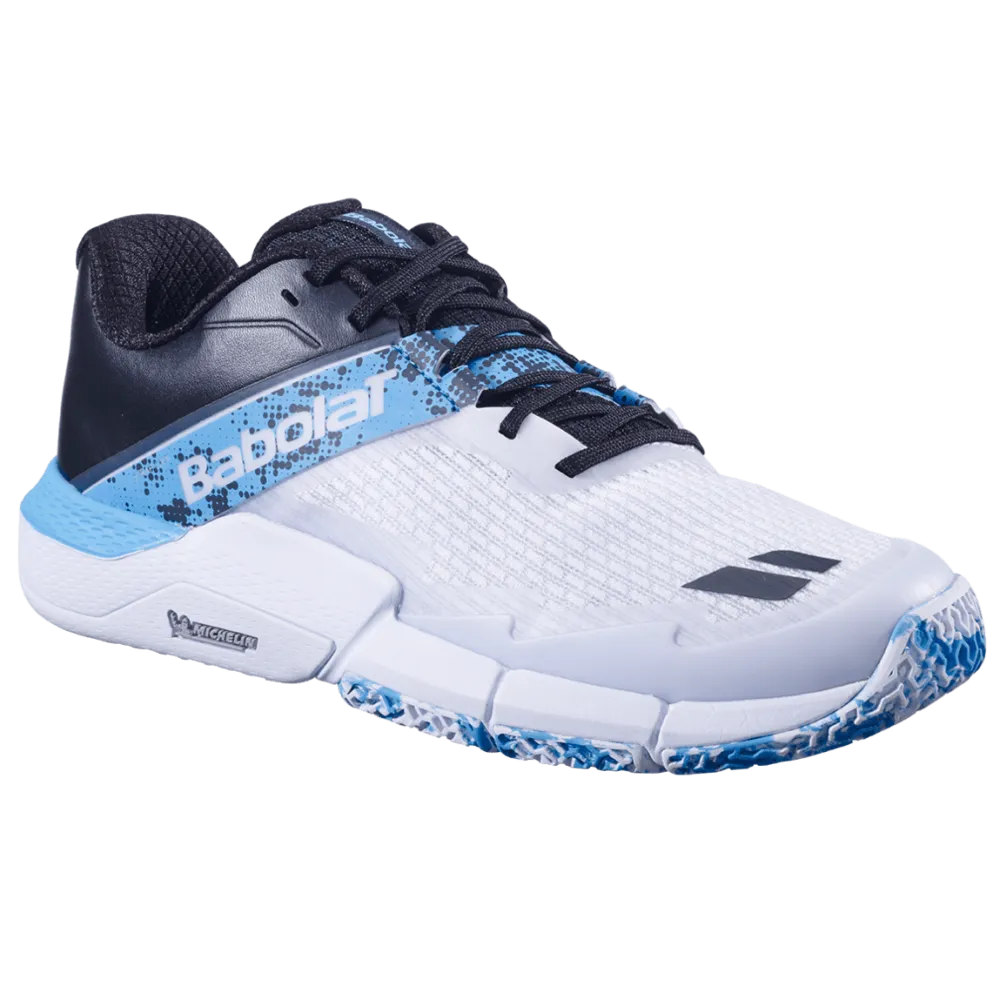 Image: Babolat
The Babolat Movea 2 is where the Babolat build quality meets everyday wearability. If the Premura 2 is the speed weapon, the Movea 2 is the shoe you reach for when you want comfort and confidence across a long session. It sits between the Premura’s featherweight feel and the ASICS stability stack — versatile enough for recreational players, solid enough for 3–4x per week. The cushioning is forgiving underfoot without feeling dead. The outsole grips indoor and outdoor padel surfaces cleanly. For players who want a Babolat shoe but find the Premura 2 too narrow or not cushioned enough, the Movea 2 is the natural alternative. Available via our affiliate link with current pricing.
- Comfortable for long sessions
- Versatile all-round performance
- Good breathability
- Babolat build quality at a lower price point than Premura
- Less technically advanced than the Premura 2 for pure speed
- Not as laterally stable as NOX or Resolution at very high playing volume
Durability: At 3x/week, expect 4–6 months. Solid durability for the price point.
Injury relevance: Good all-round option for injury-free players. If you have joint concerns, pair with the Resolution X or NOX instead.
ASICS GEL-Challenger 14 Padel

The Challenger 14 is 80% of the Resolution X at 60% of the price. It genuinely delivers GEL cushioning, decent lateral support, and padel-appropriate outsole grip at a mid-range price. If you’re currently playing in running shoes, tennis shoes, or cheap cross-trainers, the Challenger 14 is the best upgrade path. You’ll feel the difference immediately: better grip, more ankle confidence, less knee stress after matches. It won’t match the Resolution’s durability at high play volumes, and the upper materials are less reinforced. But for 1–3x/week play, it’s an excellent shoe.
- Real padel shoe quality at mid-range price
- GEL cushioning system
- Comfortable out of the box
- Good grip on indoor and outdoor surfaces
- Less durable than premium options at high volume
- Upper reinforcement is lighter — toe area can wear
- Not as stable as Resolution or NOX for very physical players
Durability: At 2–3x/week, expect 4–6 months. At 5x/week, expect 2–3 months.
Injury relevance: Good baseline protection. Upgrade to Resolution or NOX if you have specific joint issues.
Keep Reading
Frequently Asked Questions
Can I play padel in tennis shoes?
It depends on the type of tennis shoe. Clay court tennis shoes are an acceptable short-term substitute due to their herringbone outsole. Hard court tennis shoes are not recommended because their outsole provides insufficient lateral grip on artificial grass, increasing ankle sprain risk. Grass court tennis shoes should not be used as they damage the court surface and provide no appropriate grip.
What is the main difference between padel shoes and tennis shoes?
The primary difference is the outsole pattern and the lateral stability construction. Padel shoes use a fishbone or herringbone tread optimised for artificial grass, combined with a reinforced lateral edge and wider base for direction-change stability. Tennis shoes vary by court surface but are generally not optimised for the explosive lateral movements of padel on artificial grass.
Are running shoes safe for padel?
No. Running shoes are the highest-risk footwear choice for padel. They are designed for forward-motion heel-to-toe loading, with narrow bases, no lateral stability structure, and forward-direction tread patterns. Using running shoes for padel substantially increases the risk of lateral ankle sprains during direction changes.
Do padel shoes work on clay tennis courts?
Yes, with minor caveats. The herringbone pattern functions on clay, though it has shallower grooves than dedicated clay court tennis shoes, which may reduce grip on wet clay. Durability may also suffer as the outsole compound is not engineered for abrasive clay. On natural or synthetic clay courts, padel shoes are generally acceptable.
How important is lateral stability in a padel shoe?
Very important. Padel involves explosive lateral direction changes approximately every 2-3 seconds during active rallying. A shoe without adequate lateral midsole support and outsole grip allows the ankle to invert uncontrollably during these movements. Lateral stability is the single most clinically relevant feature for injury prevention in padel footwear.
What should I look for when buying padel shoes?
The four most important features are: (1) a fishbone or herringbone outsole pattern rated for artificial grass, (2) a reinforced lateral edge in the midsole for direction-change support, (3) a wider base than running shoes to increase lateral stability, and (4) toe cap reinforcement for forehand return positions. See our dedicated padel shoe review guide for specific model comparisons.
Build Your Full Recovery Plan
Injuries Hub
Diagnosis, causes, and what is actually happening in your body.
Recovery Hub
Post-match recovery, sleep, nutrition, and return-to-play.
Prevention Hub
Warm-up, mobility, strengthening — stop injuries before they start.
Best Padel Shoes
The support gear that actually helps — tested and reviewed.

