
BEST PADEL RACKETSFor Tennis Elbow: What the Evidence Does and Does Not Show
If your elbow hurts when you play, it is natural to blame the racket. The honest position is that no study yet shows a racket causes or cures padel elbow. What we have is advice from clinics, coaches and reviewers that points to lighter, rounder, lower-balance, softer rackets. Here is that advice, two rackets we link with straight labels, and five more names to consider.
See the two racketsSTUDIES LINK A RACKET FEATURE TO PADEL ELBOW — we found none, so everything on racket features here is advice, not proof
OF PADEL LESIONS ARE AT THE ELBOW — per a review in the Aspetar Sports Medicine Journal, which notes the literature is contradictory
RACKETS WE LINK — a control racket and a stiffer advanced one, each labelled honestly
In short: when your arm is sore, clinics and guides commonly advise a racket that is moderate in weight (about 355 to 370 g, lighter after an injury), round, low or medium in balance and soft in feel, and advise against a heavy, head-heavy, stiff diamond. That is advice, not proof, because no study links racket features to padel elbow. The racket is one factor among several, and persistent pain needs a clinician. Of our two links the NOX control racket fits the advice better; the HEAD Extreme One X does not, and we say so.
How we picked: we researched manufacturer specifications, retailer listings and specialist reviews. We did not test these products ourselves, and where a detail could not be confirmed we say so. Last updated: 11 Oct 2026.
As an Amazon Associate I earn from qualifying purchases. Links marked Ad are affiliate links. Where we show a price it is the manufacturer’s recommended retail price (RRP) on the date stated beside it, never Amazon’s price.
The Two Rackets We Link
One that fits the usual advice and one that does not
NOX ML10 Ventus Control (Lamperti)

A round control racket with a soft core, which matches most of the features clinics and shops mention for a sore arm, and the one of our two links we would look at first. For the NOX ML10 Ventus Control 3K 2026 the Padelmarket listing gives a round shape, low to medium balance, 355 to 375 g, a soft EVA/HR3 core, 3K carbon faces and an intermediate to advanced level. It is not light, the 3K carbon face is firmer than fibreglass, and it is aimed at players who already have a good game, so we would not choose it as a first racket. The Amazon listing is titled “NOX Control Lamperti Agility Comfort”, so confirm it is the Ventus Control 3K before you buy.
- Round shape and a soft core, the combination clinics commonly advise for a sore arm
- Control character rather than a power diamond
- A Miguel Lamperti signature model from a padel-specialist brand
- It is not light, and the 3K carbon face is firmer than fibreglass
- Aimed at intermediate to advanced players, so not for a first racket
- Retailer sources disagree on balance and weight
HEAD Extreme One X 2025
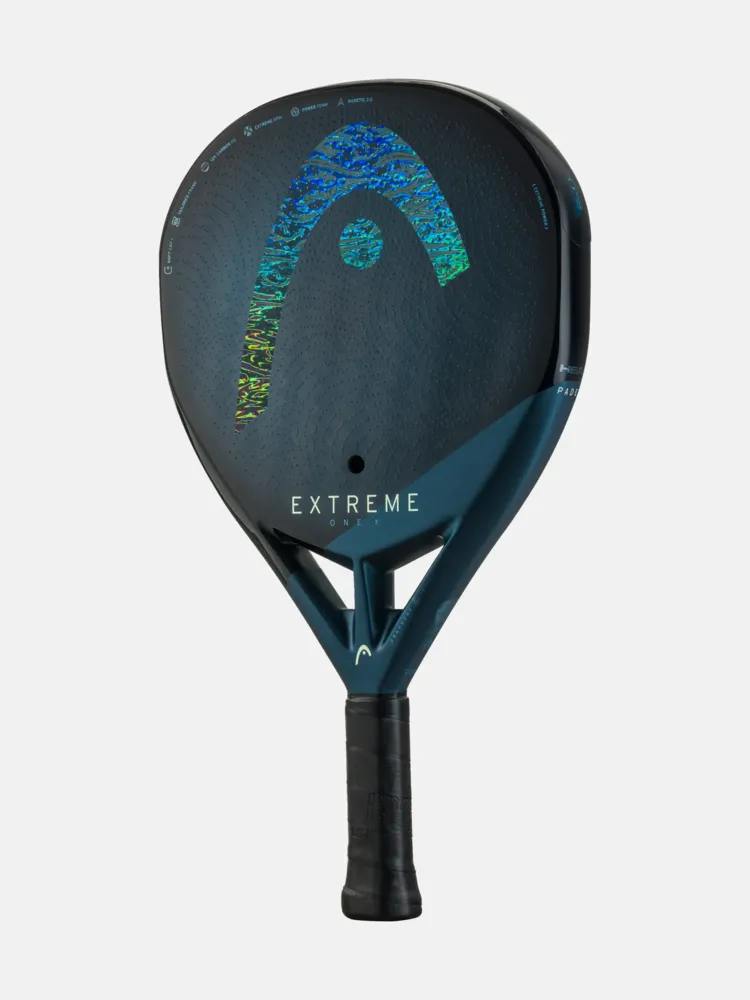 Image: HEAD
We include this racket to give you choice, but it is the opposite of what we would suggest for a sore arm. Tennis Warehouse lists it at 370 g plus or minus 10 g, with a high 270 mm balance, a diamond head, a 38 mm beam, a Power Foam core and a 12K carbon face, and says it is best suited to advanced players who can handle the weight and high balance, aggressive and skilled left-side players. Those are the features clinics and guides tell you to avoid while your arm is sore. If you are fully recovered, strong and want a Head power racket, it is a legitimate option; if you are feeling any elbow pain, choose a lighter, rounder, lower-balance racket first.
- A real power racket from a major brand, for strong and conditioned players
- Power Foam core and 12K carbon face for drive on smashes
- A fit for recovered, advanced players who want to stay with Head
- Heavy for a diamond (370 g), with a high balance, a stiff carbon face and an advanced rating, the opposite of the usual advice for a sore arm
- We do not suggest it with current elbow or wrist pain
- The lighter Extreme One 2025 is listed at 350 g, but its balance is also high, so the Extreme line is not a soft-arm family
What the Evidence Says About Rackets and Elbow Pain
Separating research from marketing
What we found
The strongest sources are not about padel rackets as such. A review in the British Journal of Sports Medicine on lateral epicondylitis in tennis reported that vibration dampers did not change vibration at the racket’s resonant frequency, that a larger head size and a higher resonance frequency were associated with less arm vibration, that improper racket weight and stringing generate high loads on the lateral muscle-tendon unit, and that a grip 6.35 mm over or under the recommended size did not significantly change forearm muscle activity (De Smedt et al., 2007). It is a narrative review about tennis, not a trial and not padel.
What padel sources say
The Aspetar Sports Medicine Journal review of padel injuries describes the elbow as the most injured specific body part, at about 20 percent of the lesions, while noting that the literature is contradictory. It names the extensor carpi radialis brevis tendon as the one most often affected, says lateral epicondylitis affects novice players more than elite ones, names vibration reaching the elbow as a cause, and lists wrong equipment, a recent change of equipment and extreme or incorrect grips as risk factors (Eirale and de Gasperis, Injuries in Padel). A sports-medicine clinic article adds that off-centre shots create more vibration, which can cause a jarring effect in the hand and forearm (Pure Sports Medicine).
A trial or systematic review showing that changing a padel racket’s weight, balance or core reduces the incidence or pain of lateral epicondylalgia. A claim that a racket “prevents tennis elbow” is marketing.
Features Commonly Advised for a Sore Arm
And how strong the support for each is
| Feature | What shops and clinics say | Support | Our line |
|---|---|---|---|
| Moderate weight | 355 to 375 g, lighter if you have been injured (TiendaPadelPoint) | Opinion; the BJSM review links improper weight to load in tennis | Avoid the heavy end, but do not go so light that you swing harder. |
| Low or medium balance | Many shops and clinics | Mechanistic opinion, not tested in padel | Keeps weight nearer your hand, so less leverage on the forearm. |
| Soft EVA core | A softer core gives more cushioning (TiendaPadelPoint) | Marketing and opinion; no padel study on cores | A comfort feature, not a proven treatment. |
| Round shape | Off-centre hits create more vibration (Pure Sports Medicine) | Consistent with the BJSM finding on larger heads, which was tennis | Fewer off-centre hits means fewer jarring ones. |
| Fibreglass vs stiff carbon face | Shops recommend flexible materials | Weak and conflicting | Stiffness is unproven either way. |
| Grip size | Aspetar lists a wrong grip as a risk factor | Weak: 6.35 mm over or under did not change muscle activity in the BJSM review | Aim for comfortable, not tight. |
Dampers and string tension do not apply
Padel rackets have no strings, so string tension and the tennis vibration dampers do not apply. The BJSM review also found that tennis dampers are not supported by evidence, so we do not recommend one.
More Candidates to Look Up
Seller-listed specs; none of these is clinically recommended
- Adidas Drive Blue 2026 Good fit on paper
Soft EVA, round shape and a fibreglass face, which makes it forgiving (Padelmarket). Balance is disputed (low per Padelmarket, even per Padelkiwi). TiendaPadelPoint’s article on rackets for elbow pain names an Adidas Drive among its picks, but that shop’s list has no cited studies, so we do not call any of these clinically recommended. Check whether the listing is the Blue or the Black 2026. - StarVie Nyra 2026 Good fit on paper, and light
Round, listed at 340 to 355 g or 350 to 365 g depending on the seller, low balance, soft S-EVA Flex core and a fibreglass face, with Padelmarket’s guide pointing to comfort and lower arm load. The lightest sensible option here. Retailer sources only, and it showed out of stock at one seller. - Bullpadel Open Control 2025 Good fit on paper, previous season
A round, head-light racket with a soft EVA core and a fibreglass face at 360 to 370 g (Central Sports). Shops disagree on the frame and balance wording. As a previous-season model it may be cheaper, but check the live price. - NOX X-Hero Blue 2026 Good fit on paper, light and soft
Listed at 350 to 360 g, round, low balance, HR3 White EVA and fibreglass faces. Retailer sources only, and we found no official NOX page. - NOX ML10 Pro Cup Coorp (2025) An alternative if you want another Lamperti model
Most often described as a control racket at 360 to 375 g with an HR3 EVA core, from one seller source. Use it as an alternative to the Ventus Control if you want a Lamperti model. Confidence is low. - Adidas Cross It Light 2026 Doubtful for a sore arm
Listed at 345 to 360 g and round with a soft Energy EVA core, but its 24K carbon aluminised face is described by sellers as a harder touch, and the balance is disputed. We would not suggest it for a sore elbow without trying it first.
What we did not find
We found no usable spec or review pages for the Babolat Viper line, StarVie Raptor, Siux rackets or the Bullpadel Hack as arm-friendly options, so we make no recommendation on them. The Hack 05 is described by one retailer as for experienced players, not as an elbow pick. For beginners rather than injured players, see our beginner racket page.
What to Avoid While Your Arm Is Sore
Commonly advised, not proven
Heavy, head-heavy diamonds
A diamond head, high balance, 12K or higher carbon and 370 g or more, as on the HEAD Extreme One X, is the opposite of the usual advice.
Round but high-balance rackets
Round does not guarantee low balance. An older Tennis Warehouse listing gives the round Head Zephyr a high 270 mm balance.
A new racket just before a tournament
The Aspetar review lists a recent change of equipment as a risk factor, so change gradually.
Anti-vibration promises
No padel evidence supports an anti-vibration claim as a cure.
Setting Up and Returning to Play
The racket is one piece of a bigger plan
Grip and setup
Aim for a comfortable grip rather than a tight one, and keep the overgrip fresh, because a slippery one can make you hold on harder. If you are between sizes, a thinner handle plus an overgrip is easy to adjust. See our overgrip guide. A brace can be a short-term aid while you heal, see our elbow support page.
Rehab matters more than the racket
If you are managing elbow pain, the plan matters more than any racket: understand what it is, load the tendon progressively and return gradually. Start with our padel elbow guide, the padel elbow versus tennis elbow explainer, our elbow prevention page and the elbow rehab programme.
Persistent or worsening elbow pain, pain at night, numbness or tingling, or weakness in the grip should be assessed by a clinician before you buy anything. A racket does not replace diagnosis.
You know the feeling: the elbow twinges on a backhand and you start eyeing a new racket. Most players don’t realise that the evidence for a racket fix is thin, and that load and recovery usually matter more. What actually works is a forgiving racket, a gradual return and a plan, and we have been through the other way and it dragged on.
Who This Is For
Players with elbow pain who wonder if their racket is part of the problem
Returning players choosing a forgiving racket after a layoff
Anyone who wants the evidence and the marketing separated
Frequently Asked Questions
Can the wrong padel racket cause tennis elbow?
We found no study showing that a particular racket causes it. A sports medicine review lists wrong equipment and a recent change of equipment as risk factors, among others. Treat the racket as one factor.
What kind of racket do clinics and guides advise for elbow pain?
Commonly a moderate weight (about 355 to 370 g, lighter after an injury), a round shape, a low or medium balance and a soft feel. This is advice and mechanistic opinion, not tested in padel.
Does a soft EVA core protect the elbow?
A softer core is designed to feel more cushioned, but we found no padel study showing it protects the elbow. It is a comfort feature.
Is the HEAD Extreme One X a good racket for tennis elbow?
We would not choose it for a sore arm. It is listed at 370 g with a high balance, a diamond head and a 12K carbon face for advanced players. It is a fit for players who have fully recovered.
Should I use a vibration damper?
Padel rackets have no strings, so tennis dampers do not apply, and the BJSM review found tennis dampers unsupported.
When should I see a clinician?
If elbow pain is persistent or getting worse, wakes you at night, or comes with numbness or weak grip, have it assessed before you spend on gear.
Keep Reading
Build Your Full Recovery Plan
Padel Elbow
Diagnosis, causes, and what is actually happening in your body.
Recovery Hub
Post-match recovery, sleep, nutrition, and return-to-play.
Prevention Hub
Warm-up, mobility, strengthening — stop injuries before they start.
Elbow Supports
The gear that actually helps — picked and explained.

