
BEST PADEL RACKETSFor Beginners: What to Look For, and Seven to Start With
Your first padel racket should be forgiving, not impressive. Round shape, low balance, a soft core and a weight of roughly 350 to 370 g is the common recipe, and we explain why. Then we go through seven rackets one by one, with who each suits and its limits. We are upfront that specs come from sellers and guides, not independent lab tests.
See the seven racketsTHE SHAPE TO START WITH — the largest, most central sweet spot; every retailer guide we read says the same
A SAFE WEIGHT RANGE — retailer guides disagree slightly; go lighter if you are small, play occasionally or have arm trouble
RACKETS REVIEWED — each labelled with who it is best for, why we like it and where it falls short
In short: for a first racket choose a round shape, a low balance, a soft EVA core with a fibreglass face and a weight of about 350 to 370 g, lighter if you are small or have arm trouble. Of our seven, the StarVie Nyra and adidas Drive Light 2026 are the lightest, the Bullpadel Indiga CTR 26 and NOX X-Hero Blue 2026 the easiest to control for the money, and the Bullpadel Ionic Control 26 the one to grow into. Specs are as sellers list them, so check the live Amazon listing, and avoid hard diamond-shaped pro rackets until your technique is ready.
How we picked: we researched manufacturer specifications, retailer listings and specialist reviews. We did not test these products ourselves, and where a detail could not be confirmed we say so. Last updated: 11 Oct 2026.
As an Amazon Associate I earn from qualifying purchases. Links marked Ad are affiliate links. Where we show a price it is the manufacturer’s recommended retail price (RRP) on the date stated beside it, never Amazon’s price. A price marked “Street price” is the price on the named retailer’s own product page on the date stated beside it; it is not Amazon’s price and not the manufacturer’s RRP, and it may have changed.
Quick picks: our top 3
The three best-supported picks first. Every product on the page is still below, grouped by use.
- 1. Best for light, forgiving first rackets and anyone who tires quickly
Light (345 to 360 g listed), soft and easy to manoeuvre; Padelful scores its handling 7.6.
- 2. Best for improving beginners who want control and a big sweet spot
A round control racket with a wide sweet spot (8.7 of 10 in the Padelful review) and easy ball exit.
- 3. Best for smaller or lighter players, and for easing the load on the arm
One of the lightest sensible first rackets: 340 to 355 g listed, soft core, low balance.
What a Beginner Racket Needs
Five things to check, in order of importance
1. Shape: round
A round racket has the biggest and most central sweet spot, so a slightly off-centre hit still works. Diamond shapes put the sweet spot higher and ask for cleaner technique. The Padelmarket Spanish beginner guide says the round shape is usually the best option, and recommends avoiding diamond at the start (Padelmarket guide). That is retailer guidance, but every guide we read says the same.
2. Balance: low or low-medium
Balance is where the weight sits. A low balance keeps it nearer your hand, which makes the racket easier to handle at the net (Central Sports). A trap: round does not always mean low balance. An older Tennis Warehouse listing gives the round Head Zephyr a high 270 mm balance. Check the balance, not just the shape.
3. Feel: soft EVA core, fibreglass face
A softer EVA core and a fibreglass face give a gentler touch and forgive mishits more than a firm carbon racket. This is the stated beginner profile in the seller guides we read. It is a comfort and forgiveness feature, not a proven injury treatment.
4. Weight: about 350 to 370 g
Sources disagree: Padelmarket lists beginner weights of roughly 350 to 375 g per model, Central Sports says 350 to 365 g. A safe line is about 350 to 370 g, and lighter if you are small, play occasionally or have arm trouble. You do not need the lightest racket on the market; the Padelmarket guide warns against heavy rackets if you have little strength or arm discomfort.
5. Grip size
Padel grip sizes use a different scale from tennis. A simple fit test is the gap between your fingertips and palm when you hold the handle (Padelshop). If you are between sizes, a thinner handle plus an overgrip is easy to adjust. Do not over-think it: a review in the British Journal of Sports Medicine found that a grip 6.35 mm over or under the recommended size did not significantly change forearm muscle activity (De Smedt et al., 2007; a narrative review about tennis, not padel). See our overgrip guide.
Hard, diamond-shaped pro rackets. Retailer guides say the sweet spot is high and mishits feel harsher. No trial shows they cause injury, so we say “harder to hit well”, not “will hurt you”.
Seven Rackets, One by One
Grouped by use: light, control, then budget. Read the Amazon listing name before you buy
Light and easy on the arm
The lightest rackets here, for players who tire quickly or are small or returning after a break.
adidas Drive Light 2026
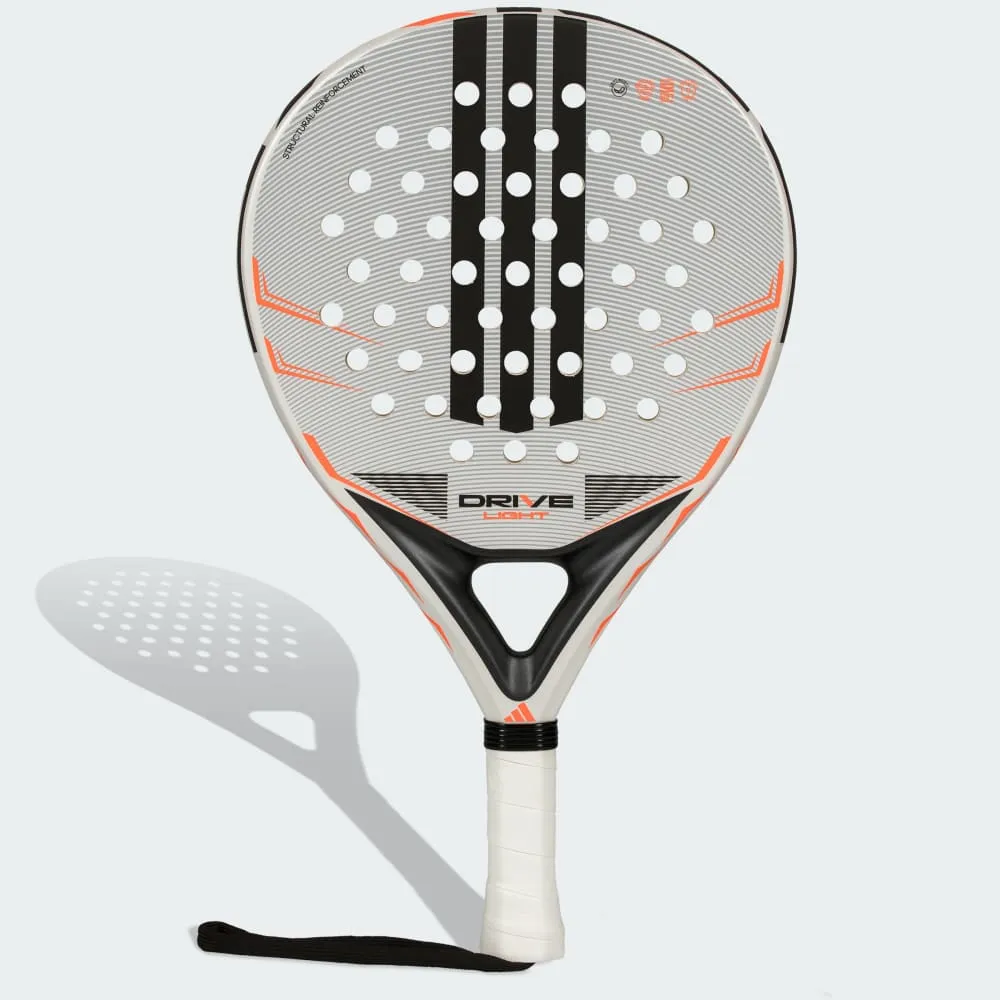 Image: adidas
A light, soft-feeling beginner racket from adidas with a fibreglass frame and face and an EVA Soft Performance core. Listings put the weight at 345 to 360 g, which is the lightest of the group apart from the StarVie Nyra. Padelful rates it 6.1 overall and describes it as control-first and easy to manoeuvre, with scores of 7.6 for handling, 6.0 for control and 5.7 for power. Why we like it: it is easy to swing for a full session and gentle on the arm in feel. Honest limit: the same review scores the sweet spot only 5.6 and rebound 5.4, so it will not rescue a mishit, and power has to come from you.
- Light and easy to manoeuvre (7.6 handling in Padelful)
- Soft EVA core and fibreglass build give a gentle feel
- A simple, calm racket for occasional players
- Sweet spot and rebound are scored low in the one review we found
- Little free power
- Sellers disagree on shape (round or hybrid) and balance
StarVie Nyra
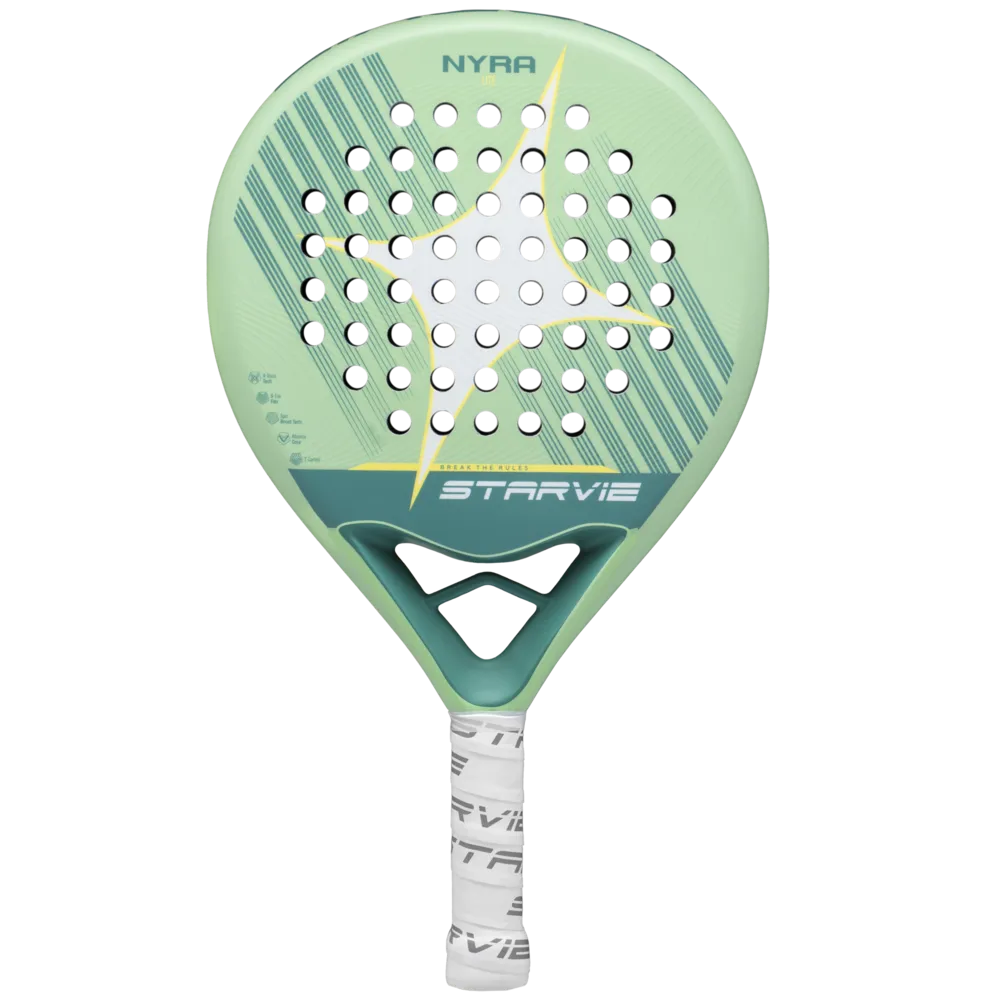 Image: StarVie
One of the lightest sensible first rackets. Padelkiwi lists the 2026 Nyra as round, 340 to 355 g, low balance, 38 mm, with an X-Glass fibreglass face and S-EVA Flex core. The Padelmarket Spanish beginner guide calls it round-compact, low to medium balance, 350 to 365 g, soft, a “light beginner” racket with a lower arm load. Why we like it: the weight stays in your hand, so it suits players who tire quickly, are returning after a break or are on the small side. Honest limit: the two sources give slightly different weights, and Padelmarket showed it out of stock when we looked.
- Very light for a first racket
- Soft core and low balance keep it easy to handle
- Described as a lower arm-load beginner racket (Padelmarket, a retailer)
- Sources differ on weight by up to 10 g
- Light rackets give less free power
- Stock may be limited
Wilson Optix V2

Wilson’s Optix V2 line comes in more than one version, and the one aimed at beginners is the Optix V2 Lite. Central Sports describes the Lite 2026 as a lightweight, beginner-friendly racket for beginner and recreational players with a large sweet spot and a control-with-easy-power style, and Padelmarket lists the Lite as round, low balance, about 355 g. Why we like it: a light racket from a brand many players already trust. Honest limit: we found no independent review of the Lite, and the Optix V2 Power is a different, more powerful racket that sellers describe as teardrop-shaped with a higher balance (265 mm), so the exact version you buy matters.
- Light, beginner-oriented version exists (Lite)
- Large sweet spot per the seller
- Well-known brand
- No independent review found
- The listing name does not say Lite or Power
- Specs differ between versions and between shops
Control and a big sweet spot
Round, low-balance rackets that reward clean contact and make defending easier.
Bullpadel Ionic Control 26
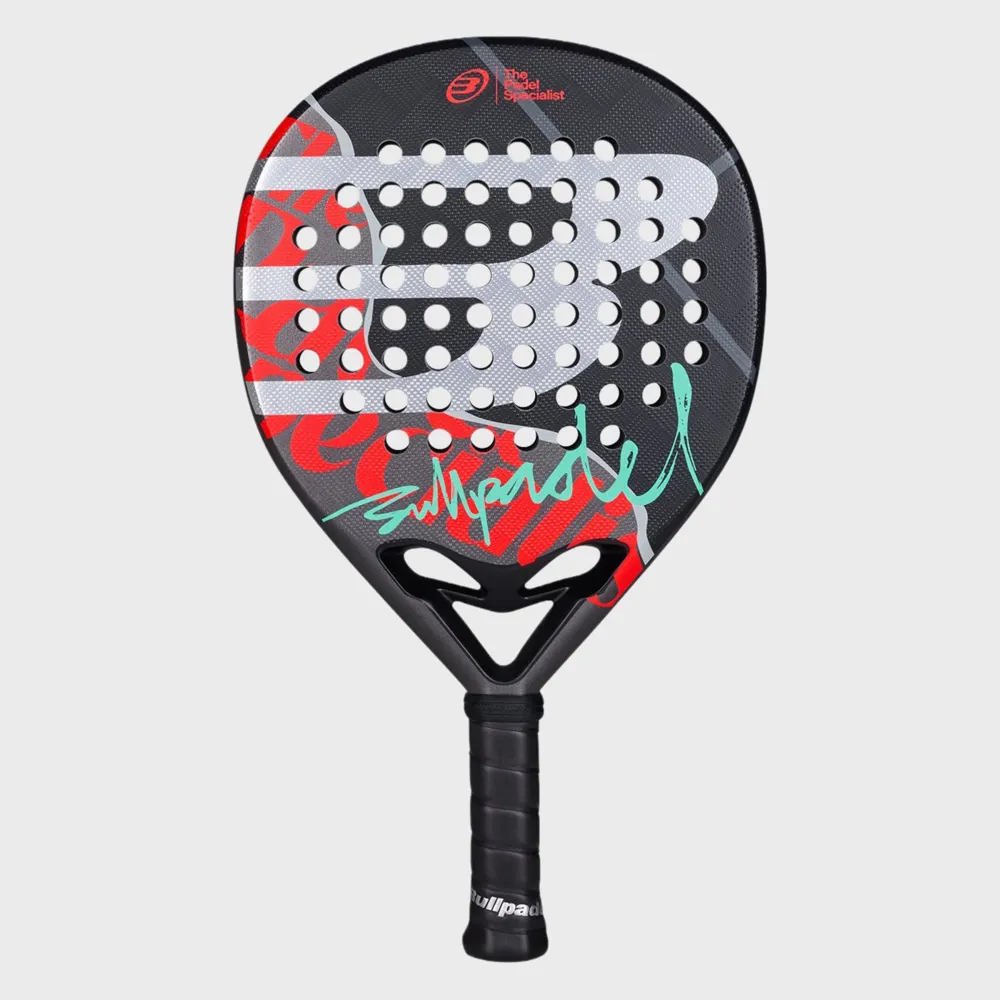 Image: Bullpadel
A round control racket from Bullpadel whose strong points, in the one review we could read, are a wide sweet spot and easy ball exit. Padelful’s 2026 scores are sweet spot 8.7, rebound 9.1, handling 8.6, control 7.8 and power 6.5, and it lists the weight at about 365 to 375 g. That makes it a little heavier than the lightest starter rackets here, so it suits a player who already has some strength and wants a racket that rewards clean contact. Why we like it: forgiving centre, easy to control, and a dual-density core meant to cope with both slow and fast balls. Honest limit: Padelful finds the smash power only adequate and says it gives little from mid-court, and we did not find a source that labels it a pure first-racket model, so treat it as an improver’s pick.
- Wide, easy sweet spot (8.7 of 10 in the Padelful review)
- Easy ball exit and good handling
- Round shape and low balance, the usual beginner profile
- Limited smash power and little help from mid-court (Padelful)
- At 365-375 g it is on the heavier side for a first racket
- Single review source; not confirmed as a beginner-level model
Bullpadel Indiga CTR 26
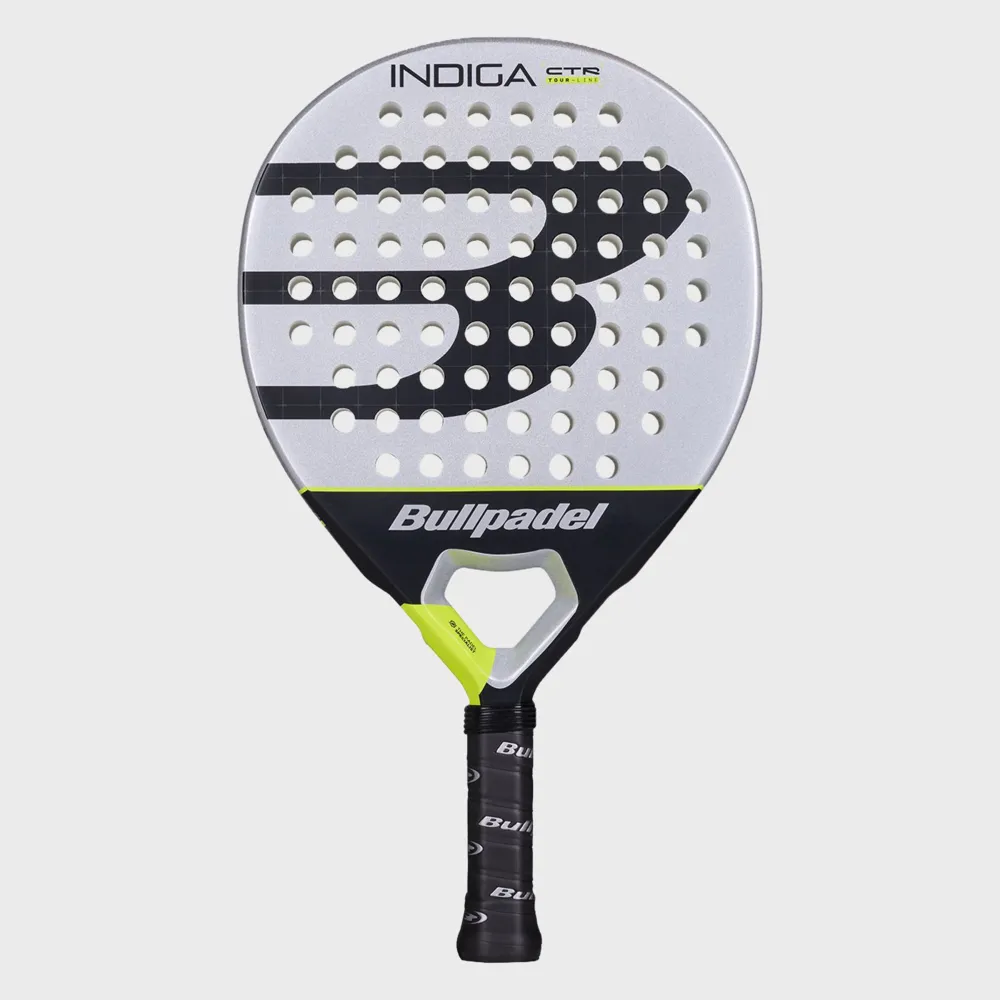 Image: Bullpadel
A round control racket from Bullpadel aimed at beginners and improvers: round, low balance, SoftEVA core and Polyglass (fibreglass) faces, listed at 360 to 370 g. Padelful rates control 7.3 and power 6.1, describes the touch as medium-soft with very easy control and high ball exit, and lists limited attacking bite as its weak point. Why we like it: it is calm and forgiving, which suits learning to defend and build points. Honest limit: little power in attack, and sources disagree on whether the frame is CarbonTube or Polyglass.
- Very easy control and high ball exit (Padelful)
- Soft core and fibreglass faces for a gentle touch
- Round shape, low balance
- Little attacking power
- At 360-370 g it is not the lightest option
- Frame material is listed inconsistently
Budget and last-season value
The cheaper end: a light starter from a padel-only brand and a previous-season Bullpadel.
NOX X-Hero Blue 2026

A light, round racket from a padel-specialist brand, listed at 350 to 360 g with a low balance, a 38 mm profile and HR3 White EVA with fibreglass faces. It is one of the easier rackets here to swing, which is the main job at this level. Why we like it: forgiving, light and from a brand that only makes padel gear. Honest limit: every spec we found comes from retailers, we could not find an official NOX page, and the “3K fibreglass” wording appears only in shop copy.
- Light and easy to swing
- Soft, forgiving core
- Specialist padel brand
- No official spec page found, so specs are retailer-listed only
- Little free power
- Not a racket to grow into for years
Bullpadel Discover CTR 2025

A round, entry-level Bullpadel from the 2025 season. Padelmarket lists it as round, 360 to 370 g, SoftEVA core, Polyglass (glass fibre) faces and a CarbonTube frame, level “iniciacion”, and describes it as made for amateur and occasional players. Why we like it: it is the plainest, most forgiving type of racket, and as a 2025 model it may be cheaper than a current one. Honest limit: this is last season’s racket, we found a single retailer page for it, and Padelmarket’s table gives it a low-balance beginner profile that we could not cross-check.
- Round and soft, the classic first-racket recipe
- A 2025 model, which retailers often discount (see the previous-season section)
- Described by the seller as made for amateur and occasional players
- Only one retailer page found, no independent review
- Last season’s model, so check the current price and stock
- Balance not stated on the page we read
Also looked at: Bullpadel Open Control 2025 (link to follow)
Retailers such as Central Sports describe the Bullpadel Open Control 2025 as a round, soft-cored beginner control racket listed at 360 to 370 g. We have no buy link for it yet, so it has no card here; link to follow.
A step up after a few months
If you play a few times a week and want one more level, Padelmarket’s guide puts the HEAD Evo Extreme 2026 (a hybrid with medium balance) as a racket for players with some months of experience. Keep it for later: start with one of the rounder, softer rackets above. We do not recommend any of the pro-level rackets on our main racket page as a first racket.
How we chose them, and what we could not check
We chose by what seller guides and the few reviews we could read agree on, not by playing with each racket, and we label every racket with who it suits and where it falls short. Nearly every padel racket spec online comes from shops that sell the racket, and shops often disagree, especially on balance. Treat weights and balances as “listed as”. We found no independent lab or coach-tested comparison of these rackets, so we cannot tell you one is better than another on the court. We did not shortlist Siux, Black Crown, Vibor-A or Dunlop because we found no beginner guide that recommended them.
Is Last Season’s Racket the Smart Buy?
Often, with two checks
The case for the previous season
Padelmarket says last year’s models are often heavily discounted while the technology changes little, and that the sale windows are new-season launches, Black Friday and January (Padelmarket). The seller has an interest, so treat it as a rule of thumb. The Bullpadel Discover CTR 2025 on this page is a previous-season model, though we did not find a source that says how much cheaper it is.
Two checks before you buy
Check the live price on Amazon, because we quote none and cannot promise a saving. Then compare shape, balance, stiffness and face material between the two model years, because some years change the construction, and sizes and weights can sell out.
Looking After Your Arm From Day One
What we know and what we do not
Equipment is one factor, not the whole story
A review in the Aspetar Sports Medicine Journal names the elbow as the most injured specific body part in padel, at about 20 percent of the lesions reported, though it notes the literature is contradictory, and lists wrong equipment, a recent change of equipment and extreme grips as risk factors (Eirale and de Gasperis, Injuries in Padel). We found no trial showing a particular racket prevents elbow trouble, so we give this as advice, not proof: pick a forgiving racket, build up play gradually, and warm up.
Choose a forgiving racket
Round, low balance, soft core. It is a comfort feature, not a treatment.
Keep the grip fresh
A worn overgrip is slippery, so you may grip harder. A fresh one is cheap and easy to change.
Build up gradually
Short sessions at first. The Aspetar review lists a recent change of equipment as a risk factor.
Warm up before you play
See our warm-up guide for a routine you can do before the first rally.
When to Upgrade
Signs you have outgrown a beginner racket
Signs you are ready for the next level
You hit the sweet spot most of the time, you want more power or more spin, and you find the racket feels light or soft when you attack. That is a sign to try a mid-range racket, ideally by borrowing or demoing one first. A racket that hurts your arm is a reason to see a clinician, not just to buy a new racket.
Looking after the racket
Keep it out of a hot car or direct sun, and out of freezing temperatures, and check your racket maker’s care notes. Replace the overgrip when it gets slippery. For storing your gear, see our padel bag guide.
You know the feeling: you buy the racket the pros use and spend a month wondering why nothing lands. Most players don’t realise that a forgiving racket is the faster way to get better. What actually works is a round shape, a low balance and a soft touch while you learn the game, and we have been through the other way.
Who This Is For
New players choosing a first racket
Returning players who want something forgiving and light
Anyone who wants the spec rules explained before they spend
Frequently Asked Questions
What is the best padel racket for a beginner?
Look for a round racket with a low balance, a soft EVA core, a fibreglass face and a weight of about 350 to 370 g. Of our seven, the StarVie Nyra and adidas Drive Light 2026 are the lightest, and the Bullpadel Indiga CTR 26 and NOX X-Hero Blue 2026 are easy-control starters.
Is a round or a diamond racket better for a beginner?
Round. It has the largest, most central sweet spot, so off-centre hits are more forgiving. Diamond shapes demand cleaner technique.
How heavy should a beginner padel racket be?
Sources disagree slightly; about 350 to 370 g is a safe range. Choose the lighter end if you are small, play occasionally or have arm trouble.
Is last year’s racket a good buy?
Often, according to a retailer, because the technology changes little and old models are discounted. Check the live Amazon price and compare shape, balance and face between the two years.
Does the racket cause tennis elbow?
We found no study showing that a particular racket causes or prevents it. Equipment is listed as one risk factor among several. Persistent pain should be assessed by a clinician.
Keep Reading
Build Your Full Recovery Plan
Padel Elbow
Diagnosis, causes, and what is actually happening in your body.
Recovery Hub
Post-match recovery, sleep, nutrition, and return-to-play.
Prevention Hub
Warm-up, mobility, strengthening — stop injuries before they start.
Rackets for Tennis Elbow
The gear that actually helps — picked and explained.

