
BEST PADEL BALLSWhat the FIP List Says, and What Nobody Has Measured
You open a can, play a few sessions and the balls feel flat. We know it. Here are three balls we picked, Bullpadel Premium Pro, Wilson Premier Padel Speed and Head Padel Pro S+ in a spin-strip bundle, with what the FIP list actually says about each and an honest note on what the makers claim but nobody has independently tested.
See the three ballsFIP BALL DIAMETER — the standard-ball range in the FIP certification booklet
FIP BALL WEIGHT — every approved ball sits in this narrow window, so differences are small and about feel and how fast they go flat
ON THE FIP LIST WE READ — Bullpadel Premium Pro and the Wilson Premier Padel family are listed; Head Pro S+ is not
In short: for most club players the Bullpadel Premium Pro is the easy all-round pick, the Wilson Premier Padel Speed is the tour-family ball for slower or cooler courts, and the Head Pro S+ bundle is the one to read carefully, because the Pro S+ is not on the FIP list we read and the spin strips go on the racket, not the ball. No independent source has measured how long any of them hold pressure, so we do not claim a winner on lifespan.
How we picked: we researched manufacturer specifications, retailer listings and specialist reviews. We did not test these products ourselves, and where a detail could not be confirmed we say so. Last updated: 11 Oct 2026.
As an Amazon Associate I earn from qualifying purchases. Links marked Ad are affiliate links. A price marked “Street price” is the price on the named retailer’s own product page on the date stated beside it; it is not Amazon’s price and not the manufacturer’s RRP, and it may have changed.
The Three at a Glance
FIP dates are from the FIP booklet we read; felt and core lines are maker or retailer claims
| Product | FIP list status | Intended conditions | Felt / core (maker or retailer claim) | Pack | |
|---|---|---|---|---|---|
| Bullpadel Premium Pro (9 balls) | On the FIP list (Premium Pro, dated 21/07/2026) | Standard ball; maker says suitable for low and high altitude (retailer) | Synthetic low-wool felt, high-density rubber core, high internal pressure (retailer) | 9 balls (3 cans of 3) per the name; confirm on Amazon | Check today’s price on Amazon → Ad |
| Wilson Premier Padel Speed | On the FIP list (Premier Padel and Premier PadelSpeed, both dated 20/02/2026) | Speed variant: made for slower courts and cooler weather (retailer) | Dura-Weave felt, core optimised for slower conditions (retailer) | Not confirmed: check on Amazon | Check today’s price on Amazon → Ad |
| Head Padel Pro S+ with Rezztek Spin Strips | Pro S+ is NOT on the FIP list we read (Head Padel Pro, Pro S and Padel One are) | Not stated by Head in what we read | Head says: thicker core formula to hold pressure longer, new padel-specific felt, recycled-PET can | A bundle: confirm contents on Amazon | Check today’s price on Amazon → Ad |
Our Three Balls, One by One
What we can confirm, and what we cannot
Bullpadel Premium Pro (9 balls)
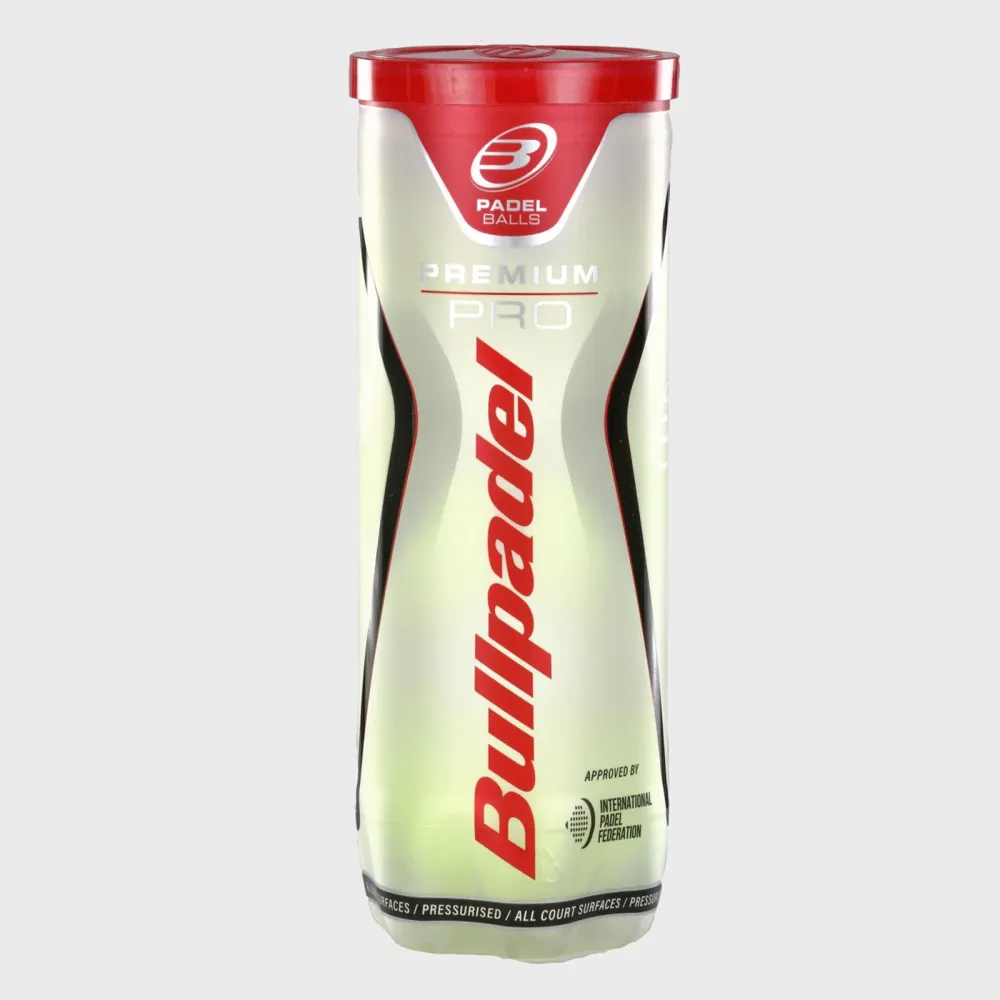 Image: Bullpadel
The ball on this page that sits on the current FIP list and is the easiest to recommend for a club player who wants one dependable ball. Bullpadel’s Premium Pro is listed by the FIP with a date of 21/07/2026, so you can use it in FIP and Premier Padel events as well as at your club. A retailer describes a low-wool synthetic felt, a high-density rubber core and high internal pressure; those are descriptions, not measurements.
- On the FIP list we read, with a recent date
- Nine balls in the pack we picked, so you are stocked for a few sessions
- Described by a retailer as suitable for low and high altitude
- No independent test of how long it holds pressure
- Older retail stock may pre-date the 2026 approval, so approval is not guaranteed for every can
- The Amazon listing title reads “Premium Balls”, so check it says Premium Pro
Wilson Premier Padel Speed

The ball that is used on the Premier Padel tour, in its Speed variant. Be clear about which one you are buying: the Amazon listing is Wilson Premier Padel Speed, not the standard Premier Padel. Wilson makes the two for different conditions, the standard ball for faster courts and the Speed ball for slower ones, and a retailer describes the Speed’s core as tuned for slower courts and cooler weather. Both are on the FIP list with the date 20/02/2026.
- On the FIP list, and the tour ball in its family
- Built for slower or cooler courts, which suits indoor halls and winter play
- A recognisable name if you play where it is used in events
- On a hot, fast court the Speed ball may play livelier than you want (our inference from the maker’s intended use, not a measurement)
- No independent durability data
- Pack size not confirmed
Head Padel Pro S+ with Rezztek Spin Strips

A Head ball in a bundle with Rezztek spin strips. Here is what we can and cannot confirm. Head says the Pro S+ is an evolution of its Pro S: faster, with a new, thicker core formula meant to hold its pressure longer, new padel-specific felt, and a can made from recycled PET. Those are Head’s claims; we found no independent measurement of pressure loss, bounce or durability. The Pro S+ is not on the FIP approved list we read, so we do not call it FIP approved. The list names Head’s Padel Pro, Pro S and Padel One only.
- A familiar brand, with a ball Head says is built to hold pressure longer
- The bundle gives you the strips to try on your racket
- Recycled-PET can, per Head
- Not on the FIP list we read, so not for FIP events unless it is approved since
- Longer life is Head’s claim; we found no independent test
- The strips belong on the racket, not the ball, and are an unproven add-on
What “FIP Approved” Actually Means
A lab spec and a listing, not a ranking
The rule and the spec
Only FIP-approved balls may be used in FIP, Premier Padel and FIP-recognised competitions. Approval lasts two years and is renewed for a fee, and the manufacturer pays for the lab tests (FIP certification booklet). So approval tells you a ball passed a lab specification, not that it is the best ball. The booklet’s standard ball has a weight of 56.0 to 59.4 g, a diameter of 6.35 to 6.77 cm, a rebound of 135 to 145 cm when dropped from 2.54 m, a forward deformation of 0.56 to 0.74 cm and a return deformation of 0.80 to 1.08 cm. The FIP Rules of Padel add an internal pressure of 4.6 to 5.2 kg per 2.54 cm² (FIP Rules of Padel).
Why the differences between approved balls are small
Every approved ball sits inside the same narrow weight, bounce and deformation windows, so what separates one brand from another is mostly feel, felt wear and how quickly the ball goes flat. The only durability test in the booklet simulates nine games, and the ball may change by no more than 0.4 g in weight and 4.0 cm in rebound. That is a pass mark, not a ranking, and the booklet gives no table of how brands compare.
The booklet states that the list on the FIP website is definitive and prevails over the booklet. We could not open the website list, so a ball approved after the booklet we read, possibly including the Head Pro S+, would not show here. Check the live list if FIP status matters for your events.
Heat, Cold, Indoors and Altitude
Mostly retailer physics, so we mark it that way
Temperature and humidity
Padel retailers explain that heat raises a ball’s internal pressure and so its bounce, that cold lowers both, and that humid air makes the felt heavier (for example TiendaPadelPoint and AllForPadel). The direction makes physical sense, but those sources show no measurements, so we cannot tell you how big the effect is. It is why Wilson sells a Speed ball for slower or cooler courts, and why we wrote that the Speed may feel lively in a hot, fast court.
High altitude
The FIP defines a separate high-altitude ball with a lower rebound of 121.92 to 135 cm. The FIP documents disagree on where it applies: the booklet gives 1,219 m and above, the Rules of Padel say more than 1,000 m, and an older booklet said 800 m, so we say roughly 1,000 m and above. All three balls on this page are standard balls.
How Long Do Padel Balls Last?
The honest answer is that nobody has published it
What we know and do not know
The ball makers make claims, such as Head’s thicker core to hold pressure longer, but we found no independent test of pressure loss, bounce or durability for any ball here. One shop says Head balls have sometimes lost pressure faster than Bullpadel or Wilson, but it names no test, so we do not use it. We also cannot give you a number of hours. Practical signs matter more: if the ball no longer bounces to a comfortable height off the floor, or the felt is bald and heavy, replace it.
Keeping balls fresh
The zero-risk advice is to keep unused balls in their original can, close it after the session and store it somewhere cool and dry, away from a hot car. Pressuriser boxes exist (Pressurebox, Pressure Pod, Bullpadel Pascal Box), but the evidence for them is seller reviews and maker claims, with no independent test, so we do not call one essential.
The Spin Strips in the Head Bundle
What they are and whether you can use them
What they are
HEAD x Rezztek “Pro Spin Strips” stick onto the hitting surface of the racket, not the ball. Rezztek says about 2 g per application, up to 50 hours of use, two per pack, and describes the product as “scientifically proven”, but shows no study we could find (Rezztek). Treat spin gains as a claim.
Are they allowed?
Neither Rezztek nor Head says anything about FIP legality. The FIP Rules of Padel require a racket to be free of objects or devices adhered to it that are not specifically used to limit or prevent deterioration, vibration or to distribute weight, and any such items must be reasonable in size and position (FIP Rules of Padel, racket rule 8). Our reading, not an FIP ruling, is that adhesive strips on the hitting face are a grey area and a referee in an official event could refuse them. For club and social play it is not an issue.
You know the feeling: the can is two sessions old and the balls already feel dead. Most players don’t realise how little separates one FIP-approved ball from another on paper. What actually works is simple: buy a ball that is on the FIP list if you play events, match it to your court’s speed, and keep it sealed between sessions. We have been through a lot of flat cans.
Who This Is For
Club players who want a ball they can trust to be legal and consistent
Players on indoor or cooler courts who are weighing a Speed ball
Players curious about spin strips who want the limits explained
Frequently Asked Questions
Is the Head Padel Pro S+ FIP approved?
It is not on the FIP list in the booklet we read, which names Head Padel Pro, Pro S and Padel One. The FIP says its website list prevails over the booklet, so check the live list before you rely on it for an event.
Which padel balls are FIP approved?
In the booklet we read, Bullpadel Premium Pro is listed with the date 21/07/2026, and Wilson Premier Padel and Premier PadelSpeed are listed with the date 20/02/2026. Many other brands are listed too.
What is the difference between Wilson Premier Padel and Premier Padel Speed?
Wilson makes the standard ball for faster conditions and the Speed ball for slower conditions. Our Amazon link is the Speed variant.
How long do padel balls last?
We found no independent data. The FIP durability test simulates nine games and is a pass mark, not a lifespan. Replace balls when the bounce is clearly lower or the felt is worn.
Do pressurisers keep padel balls fresh?
The evidence we found is seller reviews and maker claims, with no independent test, so we do not call one essential. Closing the original can and keeping it cool is free.
Can I stick spin strips on my racket in a match?
In club play, yes. In FIP events, the racket rule on adhered objects makes strips on the hitting face a grey area in our reading, so ask the referee or organiser first.
Keep Reading
Build Your Full Recovery Plan
Padel Elbow
Diagnosis, causes, and what is actually happening in your body.
Recovery Hub
Post-match recovery, sleep, nutrition, and return-to-play.
Prevention Hub
Warm-up, mobility, strengthening — stop injuries before they start.
Best Padel Rackets
The gear that actually helps — picked and explained.

