
PADEL EYE PROTECTIONSun First, Ball Impact Second
If you play outdoors, the sun is the eye risk you meet every single match, and a good pair of sport sunglasses is the answer. The ball is the rarer but more dramatic risk, and only one kind of eyewear is built for it. Here is how to tell them apart, when not to wear tinted lenses, and six pairs we picked.
See the six pairsDIFFERENT JOBS — sun protection (UV, glare) and ball-impact protection are separate things, and most eyewear does only one
BUILT FOR BALL IMPACT — only the HEAD goggle is made for it; the other five are sun glasses and we label them that way
CHECKS BEFORE YOU BUY — UV protection, lens darkness (filter category) and a stated impact standard
In short: on outdoor courts the everyday eye risk is sunlight, so wear sport sunglasses with full UV protection and a lens dark enough for the conditions. The ball is a rarer risk, but when it hits the eye the damage can be serious; for that you need eyewear that states an impact standard, and of our six picks only the HEAD goggle is built for it. Take tinted lenses off in the evening and indoors.
How we picked: we researched manufacturer specifications, retailer listings and specialist reviews. We did not test these products ourselves, and where a detail could not be confirmed we say so. Last updated: 11 Oct 2026.
As an Amazon Associate I earn from qualifying purchases. Links marked Ad are affiliate links. Where we show a price it is the manufacturer’s recommended retail price (RRP) on the date stated beside it, never Amazon’s price.
Quick picks: our top 3
The three best-supported picks first. Every product on the page is still below, grouped by use.
- 1. Best for wide sun coverage
A wide wraparound lens that covers the sky when you look up for a lob. A sun glass, not ball protection.
- 2. Best for an everyday-and-court crossover
A large-lens sport frame that also works off court; UV filtering to 400 nm per retailer text. We treat it as a sun glass, not impact protection.
- 3. Best for ball protection
The one pair here designed for a ball hitting your face: a clear polycarbonate goggle (standards are retailer-stated, check the listing). It will not cut sun glare.
In plain words
Did a stray ball find your eye instead of your racket? Let’s look at eye injuries.
- Do not touch or rub your eye until it is better. Source: nhs.uk
- Treating your eye injury from a ball impact depends on how bad it is. It may include medicine, a protective shield, resting, or urgent surgery. Source: ncbi.nlm.nih.gov
- A blunt eye injury (ocular trauma) is a real medical emergency. It requires quick examination and treatment because it can cause sudden and permanent loss of vision. Source: ncbi.nlm.nih.gov
- Symptoms of your eye injury from a ball impact may include pain, blurry or double vision, light sensitivity (photophobia), spots in your vision (floaters), or blind spots. Source: ncbi.nlm.nih.gov
- A delayed detached retina (rhegmatogenous retinal detachment) can happen weeks after your initial eye injury from a ball impact. Source: ncbi.nlm.nih.gov
- Bruising of your retina (commotio retinae) from a ball impact needs no special treatment. A special eye scan (optical coherence tomography) is recommended to check your recovery. Source: ncbi.nlm.nih.gov
Easy-read versions of the sourced facts on this topic — written with AI assistance and checked against the wording of each source. Not a substitute for medical advice.
How Sunlight Harms Your Eyes
The risk you meet every outdoor match
What UV does to the eye
Ultraviolet (UV) light from the sun does not only burn skin: it reaches the eye too. The World Health Organization points to snow blindness (photokeratitis) in skiers as the example of why UV protection has to take reflection from the ground into account, and says snow can reflect as much as 80 percent of UV radiation (WHO). Longer-term effects of UV on eye health are a question for an eye specialist; we have not cited a source for them here, so we do not list them. We did not find a measurement for padel courts or glass walls, so we will not claim a number for them.
Why outdoor padel is a sun problem
An open court gives you no roof. Lobs and smashes make you look up into the sky for part of every point, so a long match in bright sun adds up to a lot of exposure. That part is our experience as players plus common sense, not a study.
Tinted sunglasses also help with plain glare and glints off the glass, which makes it easier to see the ball. A cap or visor can help too, but we have no source on that and would not put a number on it.
A Cochrane review of 17 studies found that blue-light-filtering lenses may not reduce short-term eyestrain from computer work, and none of the studies looked at retina health (Cochrane). For padel the risk that matters is UV, so look for full UV protection and treat blue-light wording on sunglasses as marketing.
What to Look For in Sun Lenses
Three things on the label
1. UV protection
Look for a CE or UKCA mark and the words “100% UV” or “UV400” on the product. Tint and UV protection are separate things, so a lens is not safe from UV just because it is dark: read the UV claim, not the colour. Polarised lenses cut surface glare, they do not block extra UV.
2. Filter category (how dark)
Sunglasses are sorted by how much visible light they let through (ISO 12312-1): category 0 more than 80 percent, category 1 over 43 to 80, category 2 over 18 to 43, category 3 over 8 to 18, and category 4 over 3 to 8 (College of Optometrists). Category 4 is not for driving. For padel, in our experience category 2 or 3 suits bright sun, and a clear or category 0 to 1 lens suits shade and evening. Mirror coatings darken the lens further.
3. Fit, grip and extras
Wraparound shapes and a tall lens cover the sky when you look up. Rubber nose and temple pads keep a pair in place when you sweat. Polarised lenses reduce glare off flat surfaces but can make some screens hard to read; we found no study on polarisation and padel ball visibility, so treat it as a taste. Photochromic lenses that darken with light exist in the Rudy Project range; we have not tested how fast they clear indoors.
Ball Impact: Rarer, but Serious
What we know, and what nobody has measured yet
What eye doctors say about padel
Ophthalmologists at the University of Gothenburg describe the padel ball as weighing about 50 grams, with a size corresponding to the opening of the eye socket, and say a smash can reach up to 130 kilometres an hour. Most injuries they describe were mild, some caused lasting impairment, and severe cases risk blindness; the three cases they report all needed surgery. They say that if protective eyewear is used correctly, the risk of eye damage is reduced by up to 90 percent (University of Gothenburg).
An online survey of 583 Italian players found 10.3 percent reported an eye injury, and 92 percent of those were attributed to ball impact; only 9.6 percent strongly agreed that protective goggles are important (Eye, 2026). It is a self-selected, self-reported sample, and no one has population figures for padel eye injuries, so read it as a warning sign, not a rate.
Which eyewear actually protects against a ball
Only eyewear that states an impact standard has been tested for it. Marks to look for are ASTM F803 (a sports eyewear standard) or EN 166 with an impact letter (F, B or A, from lowest to highest energy). We could not confirm which standard formally covers padel, so we do not claim one; the rule of thumb is simple: if the maker names no impact standard, treat the pair as sun protection only.
That is why we label every pick honestly below. Only the HEAD goggle comes with an impact claim, and even that is a retailer claim you should check on the listing. The other five are sunglasses. A fashion sunglass lens can break and is not a ball shield.
NHS guidance suggests you do not touch or rub your eye until it is better. One source, the NHS, says to go to an emergency department or call emergency services if, after an eye injury, you have severe pain in your eye, any changes to your sight, or something has hit your eye at high speed. (NHS: eye injuries.) For the injury side see our head-injury guide and the injuries hub.
When NOT to Wear Sunglasses
Tint is for sun, not for every match
Evening, floodlights, indoor halls
A dark or mirrored lens cuts the light you need to see the ball. Use a clear lens (such as the HEAD goggle) or no tint.
Cloudy or shaded courts
A light tint or clear lens is enough. A category 3 lens in shade makes the ball harder to see.
When you expect to take a hit
Fashion or sport sunglasses with no impact standard are not ball protection. If a ball in the face is your worry, wear an impact-rated goggle instead.
Dusk with mirrored lenses
Red and mirrored lenses are made for strong sun. As the light drops, change to a clear or light pair.
The 6 Pairs We Picked
One impact goggle and five sun glasses, each labelled for what it is. We keep adding pairs, so check back.
| Pair | What it is | Impact standard we could confirm | |
|---|---|---|---|
| HEAD Impulse Racquetball Goggle | Clear impact goggle | Retailer listings claim ASTM F803 and ANSI Z87.1; not confirmed on a HEAD document | Check today’s price on Amazon → Ad |
| Rudy Project Spinshield | Sport sun shield | No impact standard stated on the pages we read | Check today’s price on Amazon → Ad |
| Rudy Project SP843806-0002 | Sport sun shield, red mirror | No impact standard stated on the pages we read | Check today’s price on Amazon → Ad |
| Oakley Flak 2.0 XL | Sport sunglass | Sources disagree; we treat it as NOT impact-rated | Check today’s price on Amazon → Ad |
| Oakley OO9517 Stunt Devil | Large sport shield | No impact standard stated on the pages we read | Check today’s price on Amazon → Ad |
| Tifosi Vogel SL | Budget sport shield | Polycarbonate lens; no impact standard stated | Check today’s price on Amazon → Ad |
Sun first
Sun glasses for open-sky courts and strong light. None of these is sold here as ball protection.
Rudy Project Spinshield

A wraparound shield-style sports sunglass from Rudy Project with a wide lens that covers the sky above you when you look up for a lob. Rudy lists the closely related Spinshield Air at 100 percent UV protection, 26 g, with anti-slip nose and temple pads; we read that page, not this exact listing, so confirm the details on the Amazon page. It is a sun glass, not ball protection.
- Wide, wraparound lens for open-sky courts
- Light frame with anti-slip pads (stated for the Spinshield Air)
- Rudy lists a clip-in prescription insert for the Air version
- No ball-impact standard stated
- The listing title says Black Matte while the lens we picked is Smoke Black: check the colour and lens on the page
- Shield lenses can fog when you sweat (our caution, not tested)
Rudy Project SP843806-0002
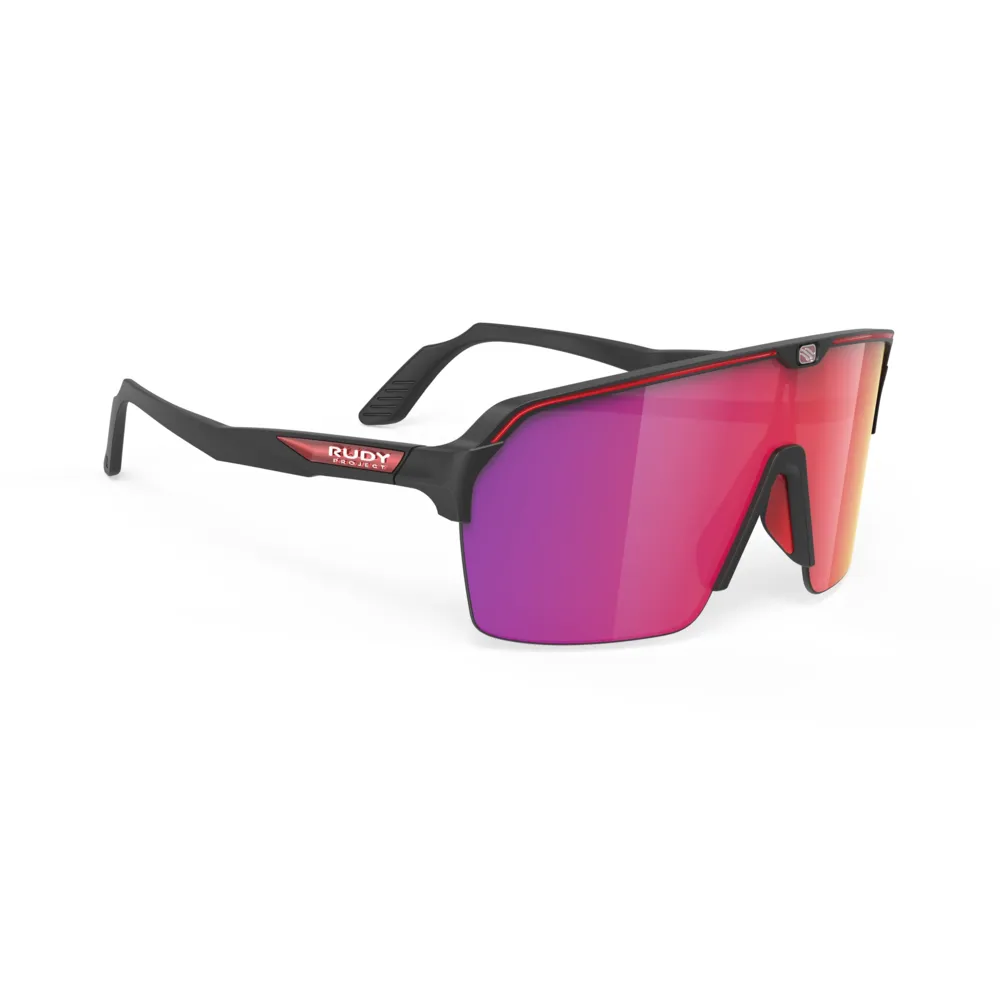 Image: Rudy Project
Rudy Project code SP843806-0002 is, according to retailer listings, the Spinshield Air in matte black with a red multilaser mirror lens. Sources we read give its light transmission as about 13 to 15 percent depending on the page, which is a dark lens aimed at strong sun. That is a lot of shade, so it is the wrong choice after sunset. Rudy states 100 percent UV protection for the Air.
- Dark mirror lens for strong sun
- Half-rim, light shield design
- Rudy sells a clip-in prescription insert for this family (sphere and cylinder only, no progressives)
- Too dark for dusk, evening or indoor halls
- No ball-impact standard stated
- Close relative of the Spinshield above: pick one if you only want one Rudy
Oakley OO9517 Stunt Devil

A 2025 large shield-style Oakley with the tallest lens in our line-up. The listing we read gives a lens height of 58 mm, which is what you want when you look up into a lob. Oakley lists 100 percent UV protection. The Amazon listing shows the Prizm Ruby lens, a red-pink tint, so check how that colour looks to you before committing. A premium sun glass, not a ball-impact product.
- Tallest lens of the six
- Wide, high-bridge fit
- Grip pads on the nose and earsocks (Oakley wording)
- Premium price tier
- One retailer lists it as not prescription compatible
- No ball-impact standard stated
Tifosi Vogel SL
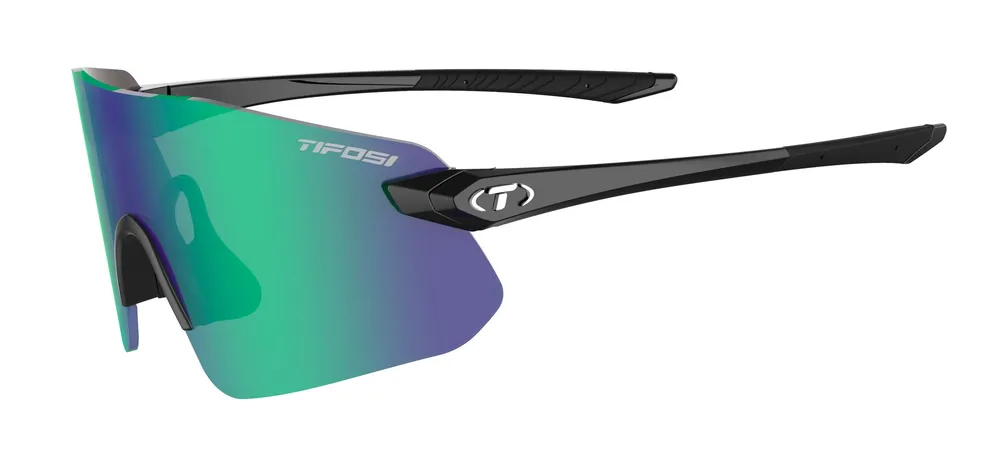 Image: Tifosi
A single-lens shield and the least expensive pair here. Tifosi describes a polycarbonate lens with UVA and UVB protection and a light TR-90 frame. If you only want to find out whether you like playing in sunglasses, start here. Tifosi sells this model in clear and tinted versions, and the Amazon title says “Transparent lenses”, so check which one you are buying: a clear one is an evening option, a tinted one is for sun.
- The budget way into sun glasses on court
- Polycarbonate lens with UVA and UVB protection (Tifosi wording)
- Light frame with nose grips
- No ball-impact standard stated
- Large sizing may not suit small faces (our caution, not tested)
- Colour and lens on the listing need checking
Everyday and court crossover
A large-lens frame that works on and off court.
Oakley Flak 2.0 XL

A proven Oakley sport frame with larger lenses for more coverage above and beside the eye. Retailer text lists a Plutonite lens that filters UV up to 400 nm. This Amazon listing is the Prizm Sapphire lens with, we believe, a white frame, so check the frame colour before you order. Oakley marketing and a safety retailer disagree on whether this style carries an impact mark, so we treat it as a sun glass and do not count on it to stop a smash.
- Large lens for extra coverage
- Well-known sport frame that also works off court
- UV filtering to 400 nm per retailer text
- Older design than the Stunt Devil
- Do not rely on it for ball impact
- Prescription option on this exact listing not confirmed
Ball impact
A goggle designed around a ball hitting your face, with a clear lens for evenings and indoor halls.
HEAD Impulse Racquetball Goggle
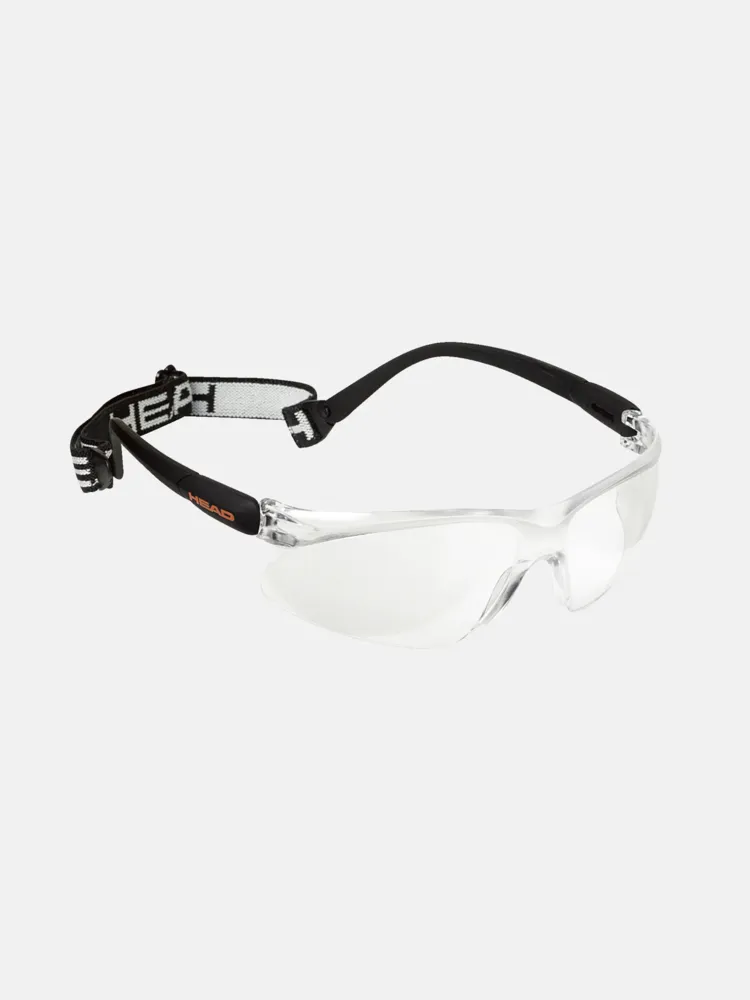 Image: HEAD
The one pair on this page that was designed around a ball hitting your face. It is a clear polycarbonate racquetball goggle, so it also works in the evening and in indoor halls. Retailer listings say it meets ASTM F803 and ANSI Z87.1; we could not find that on a HEAD document, so check the listing before you rely on it. It will not cut sun glare, and it looks like a goggle because it is one.
- Built for the job the other five do not do: ball impact
- Clear lens, so it works at night, indoors and under floodlights
- Polycarbonate lens (retailer listings), the material eye doctors point to for racket sports
- No tint: no help against sun glare
- Goggle look and fit; some players find them warm
- No prescription insert listed; fit over everyday glasses not confirmed
We have not yet verified a single pair that combines a dark sun lens with a stated impact standard for padel. Until we do, the honest set-up is a tinted sun glass for the day and the clear HEAD goggle when ball protection matters.
If You Wear Glasses or Contacts
Your options
Everyday spectacles are not made to take a ball hit, and contact lenses are not a barrier against one. Rudy Project sells a clip-in prescription insert for its half-rim Spinshield family; the insert handles sphere and cylinder, not progressive (varifocal) lenses, and you need your pupil distance. Ask an optician about polycarbonate or Trivex lenses for sports eyewear. We have not tested a prescription route ourselves.
Fit and Care
Check the fit
Nose bridge should hold without pinching, temples should rest lightly, and the lens should not touch your lashes when you blink.
Do the movement test
Look down, nod hard and lean forward. A pair that slides will annoy you mid-rally; try a different nose pad or a retainer strap.
Rinse before wiping
Rinse dust off under water, then wipe with a clean microfibre. Dry wiping a dusty lens scratches it.
Store in a case
Kit bags and rackets scratch lenses. A hard case costs little.
Retire after a hit
If a goggle or lens has taken a hard ball, replace it. We cannot see damage the lens may have absorbed, so we take no risk with eyes.
You know the feeling: the ball goes up, you look into the sun and lose it for a second. Most players don’t realise how much of that is simply the wrong lens, and how few pairs on sale were ever built for a ball in the face. What actually works is a sun pair for the day and an impact goggle for when it matters.
Who This Is For
Anyone playing on open courts in sunny regions who wants glare and UV covered.
Players who stand close to the net and want real ball protection, not a fashion lens.
Players who need a prescription route and want to know the limits.
Frequently Asked Questions
Do I need sunglasses to play padel outdoors?
Sunlight carries UV, which reaches the eye, and bright sun makes lobs harder to see. Sport sunglasses with full UV protection are a sensible choice on open courts. Pick a lens dark enough for the day and take it off or swap it in the evening.
What does UV400 mean, and is it enough?
UV400 means the lens blocks light up to 400 nm, which covers UVA and UVB. It tells you about UV protection only. It does not tell you how dark the lens is or whether it has been tested for impact.
Which filter category is right for padel?
In our experience, category 2 or 3 suits bright sun, and a clear or very light lens suits shade, dusk and indoor courts. Category 4 is very dark and not meant for driving.
Are polarised lenses good for padel?
Polarised lenses reduce glare from flat surfaces and do not block extra UV. We found no study on polarisation and padel ball visibility, so try before you decide and expect some screens to look odd through them.
Can normal sunglasses protect me from a padel ball?
Not as far as anyone has shown. Unless the maker states an impact standard, assume the pair was not tested for a ball. Of our six picks only the HEAD goggle comes with an impact claim, and that is a retailer claim you should check on the listing.
Are goggles allowed in padel matches?
We have not found a federation rule on eyewear. Ask your club or tournament organiser before you play a competition in goggles or tinted lenses.
Is blue-light blocking worth paying for?
A Cochrane review found blue-light-filtering lenses may not reduce short-term eyestrain from computer work, and the studies did not look at retina health. For padel, UV is the sunlight risk.
What should I do if a ball hits my eye?
Do not touch or rub your eye. NHS guidance says to go to an emergency department or call emergency services if, after an eye injury, you have severe pain, any changes to your sight, or something has hit your eye at high speed.
Keep Reading
Build Your Full Recovery Plan
Padel Injuries
Diagnosis, causes, and what is actually happening in your body.
Recovery Hub
Post-match recovery, sleep, nutrition, and return-to-play.
Prevention Hub
Warm-up, mobility, strengthening — stop injuries before they start.
Padel Gear
The gear that actually helps — tested and reviewed.

